
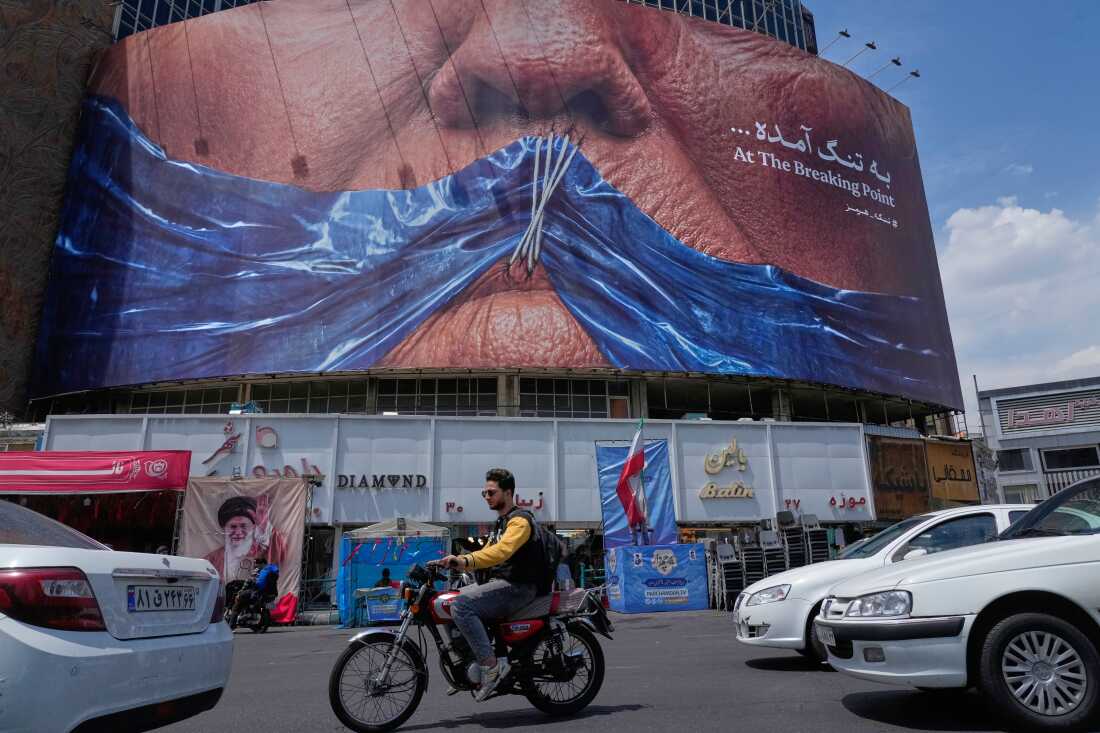
Vehicles move past a billboard showing an illustration of the Strait of Hormuz and the sewn lips of President Trump in Tehran, Iran. This imagery reflects the enduring tension between the U.S. and Iran. In February, the U.S. and Israel began military actions against Iran. President Trump initially promised a quick victory. However, nearly six months later, the U.S. remains mired in a lengthy conflict.
The war has severely affected the global economy and strained relationships with Gulf allies. It has also drained U.S. military resources, complicating President Trump’s objectives. Initially focused on curbing Iran’s nuclear pursuits, the goal shifted to regime change. Now, securing the Strait of Hormuz is the primary focus.
U.S. Treasury Secretary Scott Bessent recently announced a new sanctions campaign. He stated the intention is to “sever every economic lifeline” sustaining Iran’s regime. Countries dealing with Iran have been warned of international isolation.
Previous administrations have used economic sanctions to pressure Iran. However, Iran has kept its economy afloat, using various smuggling operations. This raises doubts about the effectiveness of further sanctions. Esfandyar Batmanghelidj, CEO of the Bourse & Bazaar Foundation, noted that maximum pressure often results in strong resistance from Iran.
After the initial military exchanges, Iran’s retaliation included missile attacks on U.S. Gulf allies. Their regional economic strategies are now being challenged. The UAE, previously a major trading partner, has halted all transactions with Iran. Miad Maleki of the Foundation for Defense of Democracies commented on the shifting landscape of sanctions evasion for Iran.
The success of the U.S. pressure campaign hinges on international cooperation, especially from China. In 2025, China’s purchase of Iranian crude oil was significant. U.S.-China discussions continue, with potential sanctions looming if cooperation fails, noted Adam Szubin, a former Treasury official.
China’s stance on U.S. sanctions could significantly impact Iran’s economy. If the U.S. imposes sanctions on Chinese entities, this could affect trade relations between the two countries. Richard Nephew, a former U.S. sanctions expert, stated that without Chinese cooperation, the blockade will still hurt Iran.
Secretary Bessent affirmed that no country is immune to U.S. sanctions, indicating a broad and firm stance.
Inside Iran, economic hardships persist. A resident from Tehran shared difficulties, including blocked bank accounts and inflated prices for basic goods. Khabar Online reported that the maritime blockade has drastically increased shipping costs. Majid-Reza Hariri of the Iran-China Chamber of Commerce emphasized the severe economic impact.
In response, Iranian officials have expressed defiance. Security Chief Mohsen Rezaei warned of potential retaliation. Analysts like Foad Izadi argue that Iran’s strategic responses reflect its leverage and resilience.