
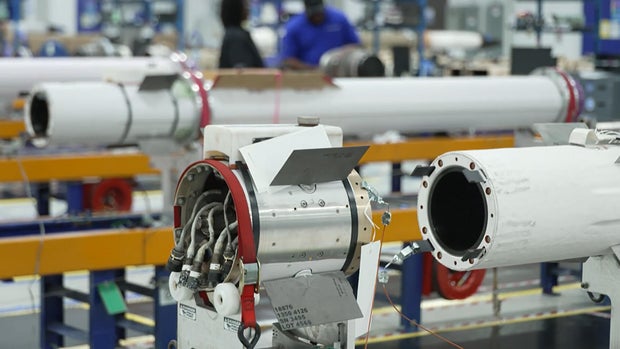
At Lockheed Martin’s production facility in Camden, Arkansas, Tim Cahill, the head of the missile division, introduced CBS News to the newest model of the Patriot air defense missile. This weapon is designed to intercept and destroy incoming ballistic missiles through direct impact.
Each missile, costing approximately $4 million, is a vital component in defense strategies. Lockheed Martin manufactures 750 of these annually; however, this number is insufficient to replace the estimated 1,500 used against Iran. Mark Cancian from the Center for Strategic and International Studies estimates that munitions fired at Iran have amounted to $25 billion in total costs.
The ongoing war with Iran highlights a shortage of high-tech weapons, an issue previously overlooked until the U.S. increased military aid to Ukraine following the Russian invasion in 2022. This conflict revealed the inadequacies in inventory and production capacity for prolonged warfare.
Cancian emphasized the significance of preparedness, stating that while the current weapons might suffice for the war against Iran, a conflict with China would present greater challenges. The Pentagon denies claims of shortages but acknowledges the need for rapid production increases.
Defense Secretary Pete Hegseth emphasizes the urgency of enhancing production capacity, pushing industry to adopt faster manufacturing methods. Lockheed Martin plans to increase Patriot missile output to 2,000 annually by extending work shifts and automating assembly lines. Despite this, supply chain issues remain, with parts sometimes relying on single-source providers.
At L3Harris, located nearby, production of rocket motors for missiles involves stringent safety measures. Manufacturing these components is time-consuming, with some processes taking weeks. L3Harris has doubled its motor production and is constructing a new automated plant, which will be operational in 16 months.
Hegseth’s insistence on rebuilding America’s arsenal aligns with high defense budgets, though public support wavers. Companies like CoAspire are contributing to this effort with innovative, cost-effective missile designs. CoAspire is manufacturing modular cruise missiles at significantly reduced costs, making it a viable option for use against advanced air defenses.
The Pentagon plans to procure 10,000 of these low-cost missiles, with CoAspire and similar companies leading in affordability. The innovative approach involves using commercial parts, like BBs for balance, to reduce costs.
Lockheed Martin’s recent $59 billion contract highlights the investment in advanced weaponry. However, replenishing stockpiles to pre-war levels may take between one to five years, depending on the munition type.
For further details:
- Lockheed Martin: Missiles and Fire Control
- Mark F. Cancian, Senior Adviser, Defense and Security Department, Center for Strategic and International Studies
- L3Harris
- CoAspire