
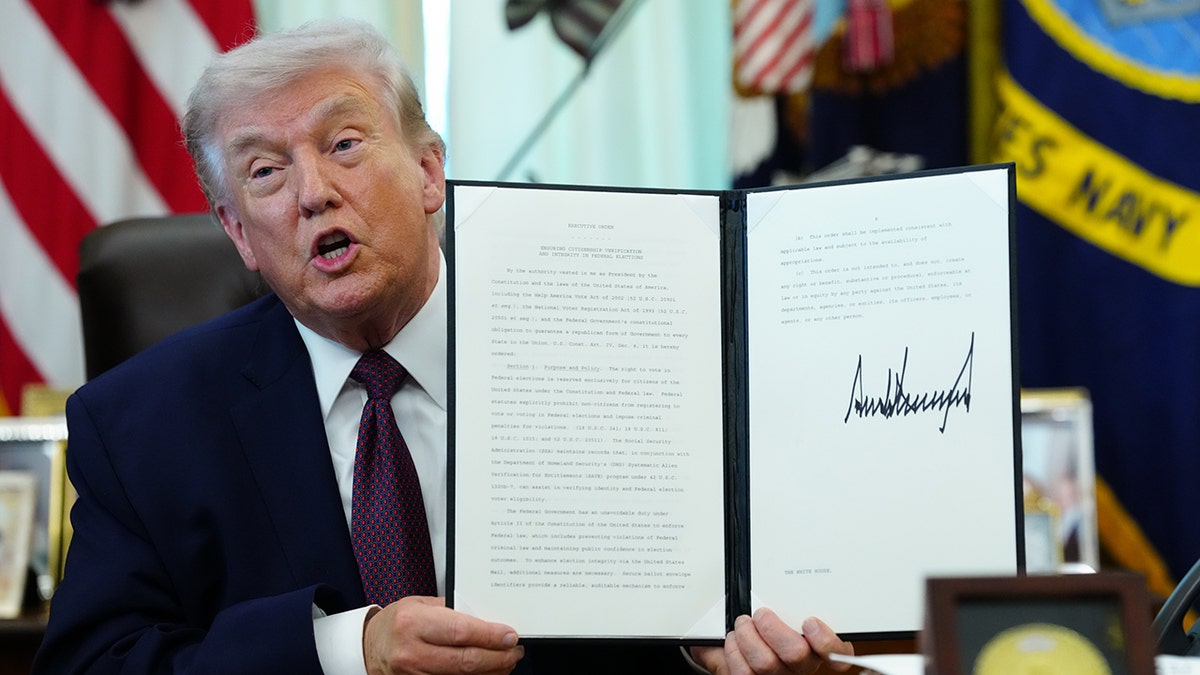
President Donald Trump is experiencing legal challenges over whether he can enforce new federal mail-ballot regulations before the 2028 presidential election. Legal experts informed Fox News Digital about the complexities involved.
In March, President Trump issued an executive order directing the Postal Service to develop new rules for federal mail ballots. These guidelines included standardized ballot envelopes with an Official Election Mail designation and unique machine-readable barcodes. According to the order, the Postal Service could reject ballots that do not comply with these new standards or those not listed as eligible mail voters.
On September 14, the Supreme Court refused to lift a preliminary injunction blocking these rules from taking effect before the midterm elections in November. The question of whether the new regulations will be implemented before the 2028 election is now a significant issue in Washington.
“If the Court views this primarily as an attempt by the President to regulate federal elections, the Court is likely to invalidate it.” — Michael Morley, Florida State University law professor
Experts believe the Supreme Court’s decision will depend on how it interprets the executive branch’s authority over mail regulation versus states’ rights to manage elections independently.
Stephen Richer from the Cato Institute argued that the Constitution does not grant the president the authority to regulate elections. The power to oversee elections lies with Congress and the states. He noted that if the requirement appears as an additional condition for mail voting, it might lead to further legal issues.
Alternatively, some view the Supreme Court’s decision as mainly a procedural matter rather than a direct critique of the administration’s efforts to manage mail voting. Justice Brett Kavanaugh, whose vote was pivotal, suggested the Postal Service likely has the authority to implement verified voter lists and secure envelopes. However, he pointed out that timing constraints made implementing the rule unfeasible before the midterms.
President Trump expressed his discontent with the Supreme Court’s injunction on Truth Social, equating it to a loss for Republicans and raising concerns over election integrity.
Although individual incidents of election and mail-ballot fraud have occurred, there is no evidence of widespread fraud in U.S. mail voting. The president’s perspective on the potential impact of the proposed mail voting rule raises unresolved questions as Election Day nears. Ilya Shapiro of the Manhattan Institute emphasized that the issue revolves around who is authorized to set mail voting regulations: the states, Congress, or a federal agency acting under comprehensive postal laws.