
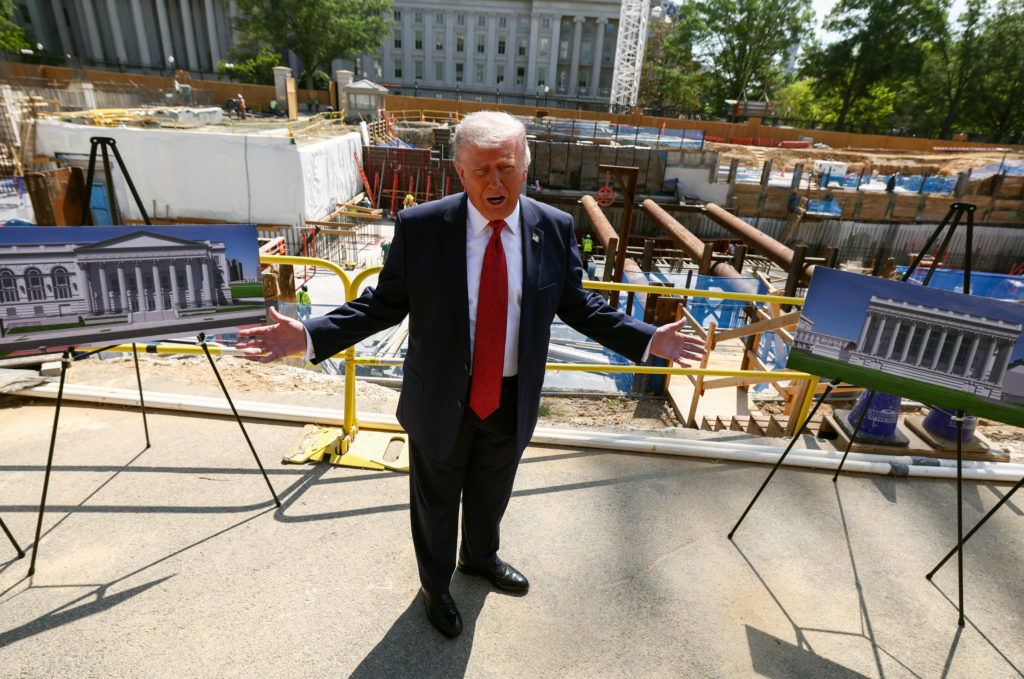
On a May evening, President Donald Trump spoke at the under-construction Lincoln Memorial Reflecting Pool. He criticized former President Barack Obama’s improvements while introducing a new “American flag blue” color for the project. A reporter questioned Trump’s focus on construction amid the Iran war.
Trump defended his priorities, emphasizing aesthetics and safety. He accused the reporter of asking a “stupid question” and complained about garbage in the pool. “Our country is about beauty, cleanliness, safety, great people, not a filthy capital,” he said.
This exchange reflects a recurring theme in Trump’s appearances since March. As the war in Iran continued, Trump concentrated on reshaping the White House and D.C. PolitiFact analyzed Trump’s public engagements, noting his focus on projects like the White House ballroom and Reflecting Pool. Trump made these projects a priority, drawing significant attention to them over other matters.
Trump’s focus on construction led to numerous public remarks, totaling nearly 45,000 words. He brought up the projects at 84 events, dedicating more to them than to the economy and immigration. Although he prioritized the Iran War in response to reporters, Trump’s personal choice discussions often returned to construction.
In May, Trump’s emphasis on these projects grew, despite initial mentions being sparse. His fixation even reached courtrooms after he accused vandals of damaging the Reflecting Pool lining. Prosecutors dropped charges against Olympic canoeist David Hearn, citing contractor flaws, not vandalism.
The White House framed Trump’s construction efforts as part of a beautification campaign preparing for America’s 250th birthday. They highlighted projects restoring national landmarks and parks, influenced by Trump’s real estate background.
Despite this, public opinion remains split. A Washington Post/Ipsos poll showed broad disapproval of Trump’s construction projects. Dissatisfaction crosses party lines, with 90% of Democrats opposed and 68% of Republicans supportive.
Trump insists on the need for a White House ballroom, a dream rooted in a 2011 conversation with David Axelrod. He emphasized its role in hosting dignitaries and its security elements after a White House Correspondents’ Association dinner shooting. Although initially budgeted at $200 million, Trump later increased the ballroom project to $400 million, citing military requests, and claimed no taxpayer funds were involved.
However, documents suggest taxpayer contributions may exceed estimates. Trump’s real estate acumen informs his focus on these grand projects, aligning with a philosophy speaking to his judgment over institutional collaboration.
As the Declaration of Independence’s anniversary neared, Trump turned more attention to the Reflecting Pool. He aimed to repair it for significantly less than prior estimates and increased his cost projections from $1.5 to $16 million by June. Trump’s claims about past repair costs under Obama and Biden differ from official records, which show a $35 million expense under Obama.
In June, the pool’s new liner exhibited damage, initially blamed on vandals, but later attributed to contractor error. Trump continued to dispute the Justice Department’s conclusions, maintaining vandals caused the damage.
Aside from the ballroom and Reflecting Pool, Trump expanded his project list. His plans included attaching his name to the John F. Kennedy Center for the Performing Arts and proposing new constructions like the Triumphal Arch.
The endeavors resonate with a presidential tradition of national beautification, seen in efforts by Harry Truman, Jacqueline Kennedy, Ronald Reagan, Bill Clinton, and Obama. However, Trump’s rhetoric centers on his personal role and identity rather than preserving national heritage.
Critics argue that Trump’s focus may discount expert opinions and historical preservationists’ input. His influence aims to leave a lasting impact on the nation’s narrative.
PolitiFact Staff Writers Alex Min, Gracey Abernethy, and Maria Briceño contributed to this analysis.