
Janelle King, co-chair of Let’s Win for America Action, examines a recent Fox News poll showing significant economic dissatisfaction among voters. King discusses how President Trump promotes ‘Trump accounts’ as offering long-term benefits; however, voters are currently experiencing immediate financial strains. Additionally, she highlights the growing influence of the far-left in crucial Midwest primaries and notes a trend towards emotional voting.
In eight weeks, many Americans will select their next congressperson. Numerous polls indicate that the economy will significantly influence their decision. It is the top issue for voters, who largely hold negative views about it.
Voters consider various issues during elections. The term ‘economy’ encompasses different meanings to them. Optimism on economic matters does not always persuade voters. While many are dissatisfied with President Donald Trump’s economic policies, this hasn’t necessarily increased enthusiasm for the Democratic alternative.
The Economy as a Central Election Issue
The significance of the economy in elections has been evident since the early 1990s, as Democratic strategist James Carville famously emphasized ‘It’s the economy, stupid’ as a campaign focus. It was one of three directives he provided to candidates at that time.
During the Trump era, the economy has remained a top-three issue, most notably in the past two midterm elections, with 47% and 18% of voters identifying it as their main concern in 2022 and 2018, respectively. In 2018, healthcare (26%) and immigration (23%) were higher priorities, contributing to Republicans losing 42 seats.
Notably, another of Carville’s rules urged candidates not to forget healthcare. Economic conditions impact other major issues, including healthcare. Despite a robust economy, the GOP faced challenges in previous elections, and healthcare remains significant this year, closely ranked behind the economy in current surveys.
Varying Perceptions of the Economy
Voters hold differing opinions about the economy when pollsters inquire about its importance or satisfaction with Trump’s economic performance. In some areas, Trump boasts a solid economic record, with 162,000 jobs added recently, tripling economists’ expectations. The unemployment rate remains steady at 4.1%, while the stock market grows despite international challenges like Iran and tariff issues.
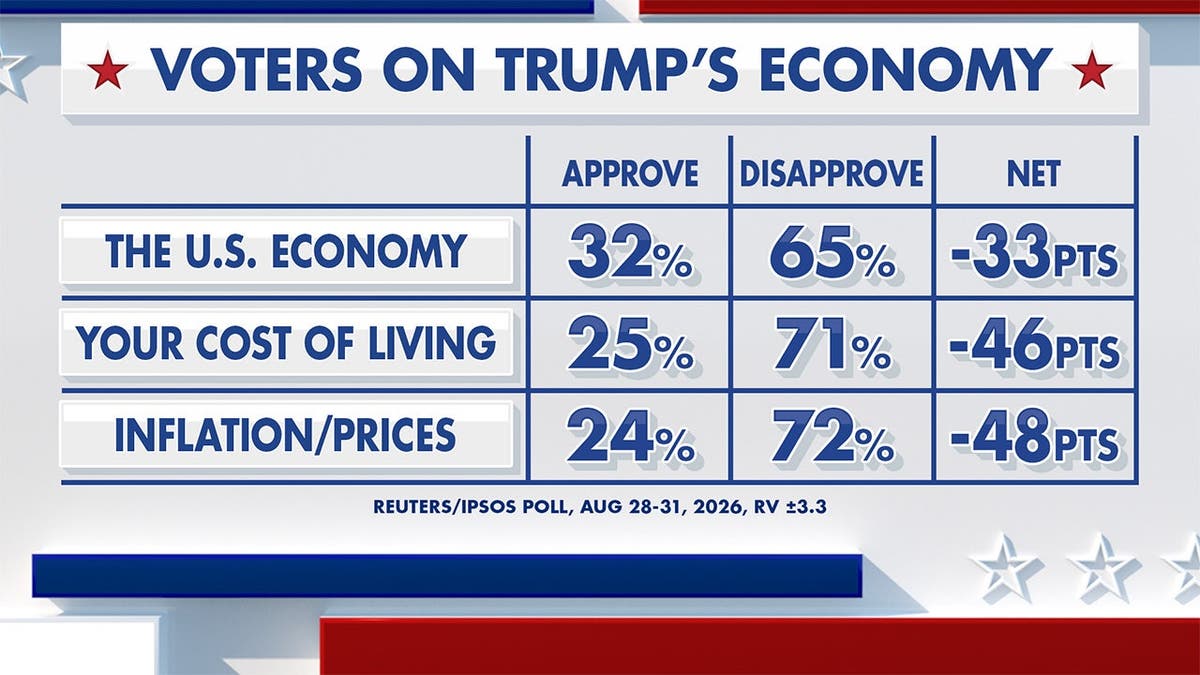
These factors have kept Trump’s overall economic approval rating low to mid-30s in several summer polls. However, when focusing on personal economic situations, results differ. A recent Reuters/Ipsos poll showed only 32% approval for Trump on the economy, with lower approval for cost of living and inflation.
Living expenses, including gas and food, heavily influence this disparity. If Democrats perform strongly in November, low presidential approval ratings on these issues, around the mid-20s, will be a contributing factor.
Economic Optimism and Voter Perception
In 2022, President Joe Biden faced similar challenges, with economic recovery underway but inflation remaining around 8% for the year. Gas prices hovered at $3.75.
The Biden administration touted positives, initially describing inflation as ‘transitory’ and later highlighting ‘zero percent inflation’ from month to month as a win, despite the high annual rate. Voters, however, were not persuaded and the GOP gained control of the House after a net Democratic loss of nine seats, with Biden’s net economic approval at -23 points.
Currently, inflation stands at 3.4% while gas prices are slightly higher at $4.15. Trump’s economic approval has dropped to -33 points. The Trump administration is using a similar strategy; Vice President JD Vance recently suggested the administration has kept gas prices from being worse.
Such optimism remains challenging to sell to voters.
Voter Concerns with Economic Alternatives
While Democrats could potentially see success in November, polls show voters also express dissatisfaction with the Democrats’ economic messaging.
Current Democratic proposals feature competing economic visions. While some propose a system overhaul with initiatives like ‘Medicare-for-all,’ others emphasize reversing Trump’s agenda while maintaining America’s core economic system.
The appeal of such visions to voters remains uncertain, as does the contrasting perspectives’ role in voter satisfaction.
In a Reuters/Ipsos survey, 36% of voters favored Republicans for economic management, compared to 37% for Democrats, within a ±3.3pt margin of error.
The Democrats currently lead the House race with 212 seats compared to the GOP’s 206, with 17 highly contested seats. A favorable night for Democrats could yield 229 seats, while favorable GOP outcomes might maintain their current majority.
Impact of Redistricting and Scandals
In Missouri, redistricting rulings have influenced congressional races. The Missouri Supreme Court blocked new district maps pending voter approval, restoring the existing map. This change benefits Democrat Emanuel Cleaver in the 5th District.
In Ohio, allegations against Republican Max Miller have made the 7th District more competitive. Additionally, districts represented by Mike Turner and Mike Carey are unexpectedly competitive as Democrats perform well in Senate races led by Sherrod Brown.
These shifts indicate a dynamic electoral environment as midterms approach.