
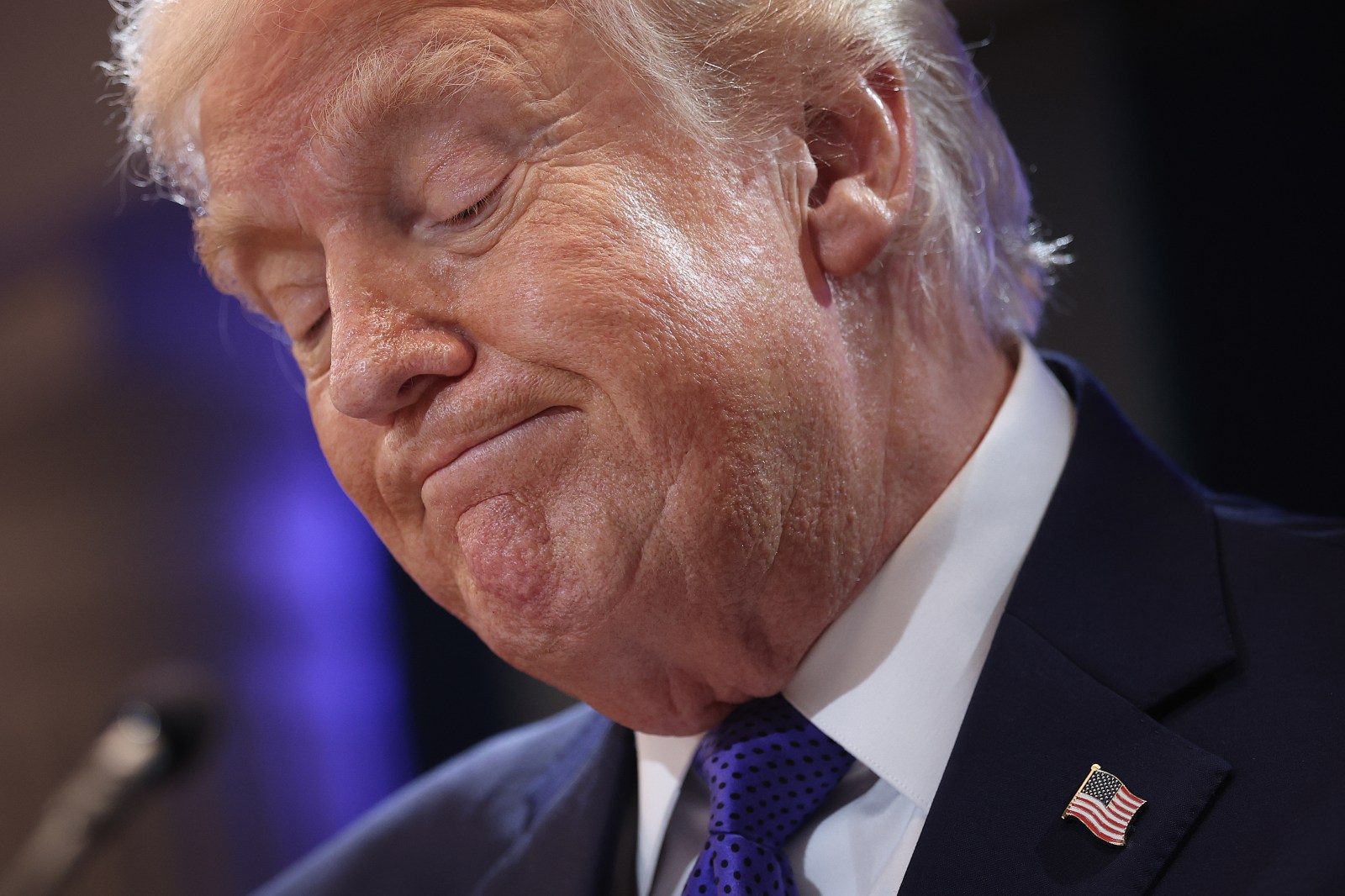
President Donald Trump expressed his disapproval of the Supreme Court’s recent decision after the justices dismissed efforts to reinstate a Republican-endorsed Missouri congressional map for the third consecutive time. Trump conveyed his frustration on Truth Social, asserting that the Supreme Court consistently blocks Missouri’s chances for an election victory despite favorable judgments from lower courts.
Trump commended Missouri Governor Mike Kehoe and local supporters committed to upholding fairness and election security. He noted his triumphs in Missouri in previous elections. The post followed an ongoing redistricting dispute seen as a potential means for Republicans to secure an extra U.S. House seat in the 2026 midterms, which Republicans had originally anticipated. Newsweek has sought comments from the White House regarding this matter.
Missouri Redistricting Efforts in Challenge
Friday’s ruling marked another hindrance for Republicans aiming to enforce a congressional map approved by Missouri lawmakers in 2025, which garnered Trump’s backing. The Supreme Court cited potential electoral chaos that might ensue from altering district lines after ballots had been printed and distributed.
The ruling pointed out that Missouri had already commenced absentee voting, along with military and overseas voting, under congressional districts determined following the 2020 census. The revised map had sparked hope among Republicans for gaining a seventh House seat from Missouri, a state currently represented by six Republicans and two Democrats in Congress.
Understanding Missouri’s Redistricting Dispute
The contentions surrounding the congressional map arise from its approval by Missouri Republicans in 2025, asserting that it better aligns with the state’s Republican inclination ahead of the midterms. Proponents argued the revised map exemplifies Missouri’s Republican lean more accurately, while detractors believed it aimed to fortify the GOP’s hold on power.
Tensions intensified when the organization People Not Politicians amassed signatures for a statewide referendum contesting the map. Although Missouri Secretary of State Denny Hoskins initially dismissed the petition, asserting that referendum procedures were inapplicable to congressional redistricting, the Missouri Supreme Court contradicted this decision, affirming the referendum’s legality and timeliness, and stipulating voter approval for the map’s enactment.
Numerous lawsuits have arisen from this dispute, spanning both state and federal courts.
Analyzing the Supreme Court’s Justification for Blocking
The Supreme Court’s latest verdict concentrated primarily on timing aspects rather than the map’s intrinsic value. By the instance the case reached the justices, election officials in Missouri were already executing the general election under preceding district boundaries.
“Ballots utilizing the 2022 map have been printed and dispatched,” the court stated. “Absentee voting is underway, alongside military and overseas voting.”
The decision appeared to hinge on declarations from state election officials deeming the transition back to the 2025 map impractical at such a belated stage. Consequently, voters will engage with ballots reflecting district lines familiar since Missouri’s 2022 and 2024 elections.
Trump’s Continuing Criticism
Trump persistently denounces judgments blocking the Republican-endorsed map. Following the Missouri Supreme Court’s ruling on September 3 necessitating voter approval prior to the map’s activation, Trump labeled the ruling a “Dark Day for ‘Justice’ in Missouri.” He criticized the court’s choice as “horrible, ridiculous, and unConstitutional,” warning it could sow chaos by altering congressional districts in close proximity to elections.
Both Trump and the Republican National Committee denounced the court’s action. Ally Triolo, the RNC’s director of election integrity communications, castigated the ruling as “reckless and wrong,” indicating the party was evaluating potential appeals.
Impact of Missouri’s Map Alterations
Significant adjustments in the 2025 map affected Missouri’s 5th Congressional District, embracing a large portion of Kansas City and represented by Democratic Representative Emanuel Cleaver. The modified boundaries excised segments of Kansas City from the district, extending its reach into more rural Republican locales.
Advocates perceived the changes as advantageous for broadening Republicans’ influence within Congress, especially in a state where Trump enjoyed pronounced support throughout his campaigns. Critics contended the map’s design undermined Democratic voter strength, skewing the contest for House control in favor of Republicans. With the GOP holding a narrow majority in the chamber, the battles over congressional maps have garnered intensified scrutiny as the midterms approach.
Upcoming Steps Before Election Day
The controversy regarding the map slated for use in the 2026 election appears resolved. Scheduled for the November ballot, voters have the opportunity to approve or reject the 2025 congressional map. If enacted, the map will become effective post-election; a rejection means retention of current district configuration.
Opponents anticipated Friday’s pronouncement with approval. Richard von Glahn, of People Not Politicians Missouri, expressed contentment with a rebuff to politically-driven maneuvers circumventing Missouri’s constitutional process. He emphasized the pivotal role of the populace, rather than politicians, in adjudicating control at the national level, urging voters to reject Proposition A.
For now, the Supreme Court’s decision ensures Missouri’s November election proceeds under the district boundaries consistent with the state’s past two electoral cycles.