
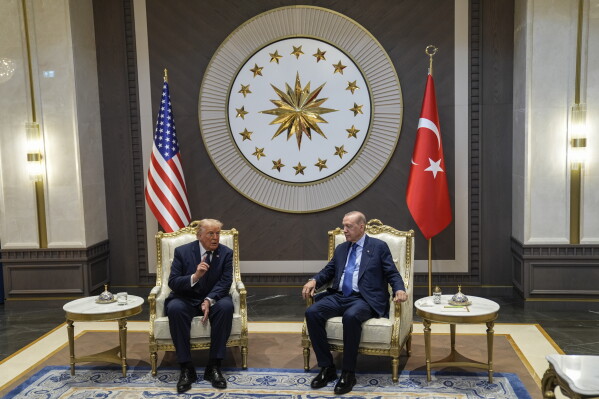
President Donald Trump has reiterated the United States’ interest in controlling Greenland, sparking renewed tensions with Denmark, a NATO ally. Trump’s statement came during a meeting with Turkish President Recep Tayyip Erdogan in Ankara. He labeled Greenland as crucial for U.S. security, citing unfounded threats from Chinese and Russian naval activities.
Addressing this issue during the NATO summit, Trump emphasized that Greenland should be under American control, not Danish. This stance is in contrast to NATO’s foundational principle of mutual defense and respect for territorial sovereignty among its 32 member nations.
Alongside the Greenland debate, Trump announced the lifting of U.S. sanctions on Turkey. These sanctions were originally imposed due to Turkey’s acquisition of the Russian S-400 missile defense system, a purchase that led to Turkey’s expulsion from the F-35 fighter jet program. Trump suggested this move aligns with his positive relationship with Erdogan.
Trump expressed willingness to reconsider Turkey’s purchase of the F-35 fighter jets, highlighting what he perceives as Turkey’s loyalty to the United States. Erdogan’s aspiration to regain access to the fighter jets remains strong, though legal barriers persist.
The lifting of sanctions marks a significant step in improving U.S.-Turkey relations, but raises concerns among allies. Israeli Prime Minister Benjamin Netanyahu voiced opposition, warning that supplying Turkey with F-35s could destabilize the region. Similar apprehensions have been voiced by U.S. lawmakers, contingent on Turkey’s ongoing possession of the S-400 systems.
NATO Secretary General Mark Rutte highlighted NATO’s investment in new military projects. At the summit, Rutte emphasized NATO’s substantial financial commitments, reflecting efforts to satisfy Trump’s previous concerns about inadequate defense spending by European allies.
Key announcements included the acquisition of Swedish-manufactured GlobalEye surveillance aircraft by a consortium of NATO member nations. Furthermore, a multinational effort to secure air-to-air refueling and transport planes from Airbus was declared.
Ukrainian President Volodymyr Zelenskyy advocated for Ukraine’s NATO membership. He underscored Ukraine’s significant military experience and contributions, stressing the importance of heightened NATO defense capabilities in response to Russian aggression. Zelenskyy’s meeting with Trump in Ankara seeks to bolster Ukraine’s case for alliance inclusion.
This advocacy reflects broader concerns over potential Russian hybrid attacks on European soil, as noted by a senior NATO official. Despite reckless Russian actions, such as airspace violations, NATO’s deterrent efforts have been effective.