
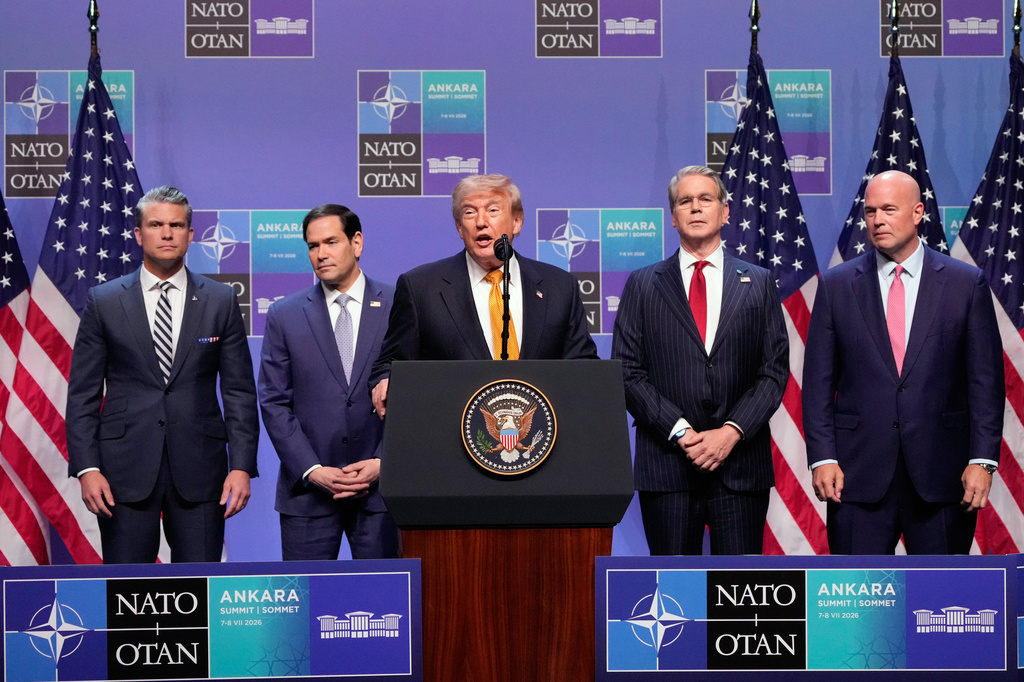
President Donald Trump, alongside key figures such as U.S. Defense Secretary Pete Hegseth, U.S. Secretary of State Marco Rubio, U.S. Treasury Secretary Scott Bessent, and U.S. Ambassador to NATO Matthew Whitaker, addressed a media conference during the NATO summit in Ankara, Turkey, on July 8, 2026.
Current conflicts in Europe and the Middle East are expected to conclude eventually. When that happens, military resources will be available for global deployment. It’s crucial for the U.S. to focus on this eventuality. Russia has a history of using military force to achieve political goals. Examples include Georgia in 2008, the annexation of Crimea in 2014, and the full-scale invasion of Ukraine. These actions show Russia’s offensive goals, not defensive ones. Its efforts to maintain a war-time economy, its tolerance for high casualties, and its willingness to endure significant sanctions highlight its resolve. The regime prioritizes ambition over human life, posing a threat to Eastern Europe’s fragile democracies. Countries like the Baltic states, Poland, and even NATO face ongoing challenges.
Effective counteractions require European partners to address gaps arising from Pentagon force reductions in eastern regions. Meanwhile, China’s Communist Party extends its influence globally through economic pressure, cyber activities, and political maneuvers. While it speaks of “reunification” with Taiwan, China hasn’t engaged in major warfare for centuries. Its last significant external military action was in 1979 and did not end well. China’s military strategies emphasize deterrence and information control over open conflict. Although it possesses advanced weaponry, the People’s Liberation Army lacks recent combat experience. An amphibious invasion of Taiwan would be historically unprecedented, likely uniting Western nations against Beijing and threatening China’s economic stability and political control.
The U.S. should continue to strengthen alliances in the Indo-Pacific, enhance deterrence measures, and ensure navigational freedom. Strategic prioritization requires focusing on active conflicts rather than hypothetical ones. Historically, Europe has been central to Western democracy. U.S. military contributions during both World Wars helped prevent continental tyranny. American leadership and NATO’s unity forged peace and prosperity afterward. Today, this legacy faces significant challenges akin to the Cold War era. A robust Europe sends a clear message to global adversaries. As the U.S. shifts focus to the Indo-Pacific, it’s vital to maintain commitment to European security to deter aggressors.
“While focusing on the Indo-Pacific, our gaze is laser-focused on the wolf closest to the sled.”
Russia’s aggressive actions aim to weaken NATO. Hesitation among Western countries creates opportunities for Putin. Thus, demonstrating resolve and strategic clarity is vital. Strengthening NATO’s eastern defenses and modernizing European command infrastructure are critical for deterrence. Current U.S. weapons programs and procurement priorities focus on a potential future conflict with China, which may not materialize. In the meantime, American munitions supplies are depleting in Europe and the Middle East, exposing vulnerabilities in industrial capacities, particularly in artillery and missiles. The U.S. must enhance its defense production capabilities to address current threats effectively.
Strengthening NATO does not compromise the Indo-Pacific position; it fortifies global deterrence by signaling resistance to aggression wherever it emerges. The U.S. Army and Air Force require renewed investment for land and air dominance in Europe. Rapid logistics, internal line coordination, and intelligence efforts are crucial. Aligning resources to these strategic needs is essential. When China sees Western defense’s steadfast commitment, it is itself a form of deterrence. A united NATO reduces the likelihood of Beijing testing Western resolve. Protecting Europe impacts Pacific peace indirectly.
Misdirecting American military focus elsewhere could be disastrous. Russia currently alters borders with military aggression. Confronting this decisively will support European allies and reduce future strategic dilemmas, ultimately saving American lives by addressing issues before they escalate.
Keith Self, representing Texas’s 3rd District, serves on the House Foreign Affairs and Veterans’ Affairs committees and chairs the Europe Subcommittee. He spent 25 years in the U.S. Army.
Copyright 2026 Nexstar Media Inc. All rights reserved.