
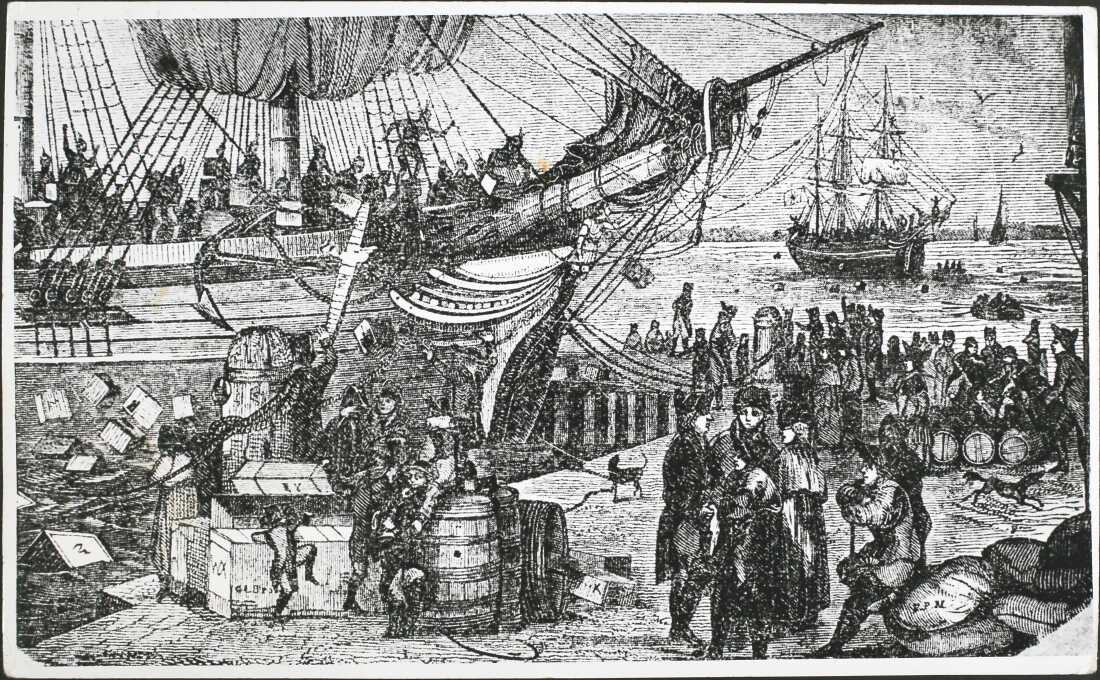
The Boston Tea Party on December 16, 1773, marked a significant act of defiance by American colonists. They threw overboard British East India Company tea into Boston Harbor. Some say this event shifted Americans’ preferences towards coffee. However, one historian asserts that coffee was already widely consumed long before this time.
The Boston Tea Party as an Iconic Event
The Boston Tea Party remains iconic in the colonial struggle. It reinforced tea’s status as a central beverage of that era. The protest became crucial in paving the path for revolution. But during the quest for independence, coffee played its part too. Coffeehouses emerged as centers for revolutionary discourse and planning.
Early Coffee Consumption
Colonists had been indulging in coffee long before the nation’s inception. Europeans introduced coffee to America. Historian Michelle Craig McDonald highlights the use of a mortar and pestle on the Mayflower in 1620 for grinding coffee beans. This was not surprising, considering many aboard had roots in Amsterdam, a major coffee trading hub in the 17th century.
The first coffeehouse in the American colonies appeared in Boston in 1676. This preceded American independence by almost a century. Earlier still, taverns also served coffee. Thus, coffee was deeply entrenched in colonial society.
The Myth of the Tea-to-Coffee Shift
During the Boston Tea Party, colonists dumped over 92,000 pounds of tea to protest the Tea Act of 1773. This Act, granting monopoly of tea sales to the British East India Company, outraged colonial merchants. They were frustrated by undercut competition and lingering taxes on tea.
In solidarity, some patriots encouraged a switch to coffee. John Adams, in July 1774, wrote to his wife Abigail, describing his journey away from tea. Yet, McDonald mentions colonists were already avid coffee drinkers. In the 1760s and ’70s, coffee was often cheaper and more accessible than tea.
Revolutionary Coffeehouses
Coffeehouses served as revolutionary hubs. Places like the Green Dragon in Boston and Philadelphia’s Old London Coffeehouse were centers for planning. In Britain, coffeehouses were called “penny universities” for their role in disseminating information and debate.
Coffeehouses in America often housed business directories and newspapers, linking traders and expanding business knowledge. Though different from taverns, coffeehouses could serve alcohol, and sometimes coffee was served in taverns too. Yet, coffeehouses were generally more exclusive and often men-only.
Coffee as a Revolutionary Drink
Both tea and coffee were part of the growing global trade network. Coffee thrived in the Caribbean, while tea hailed from China. Increased supply made coffee more accessible by the revolution’s time. This burgeoning trade also introduced luxury coffee and tea items, prompting investment in related goods like tables and silver pots.
However, coffee’s history was marred by the use of slave labor. By 1790, half of the world’s coffee came from the French colony of Saint-Domingue, now Haiti, where enslaved people faced severe exploitation. This highlighted a contradiction: the independence ideals fueled by coffee conversations contradicted the exploitation behind its cultivation. Author Mark Pendergrast emphasizes coffee’s dual role in promoting revolutionary thought while depending on slavery.