
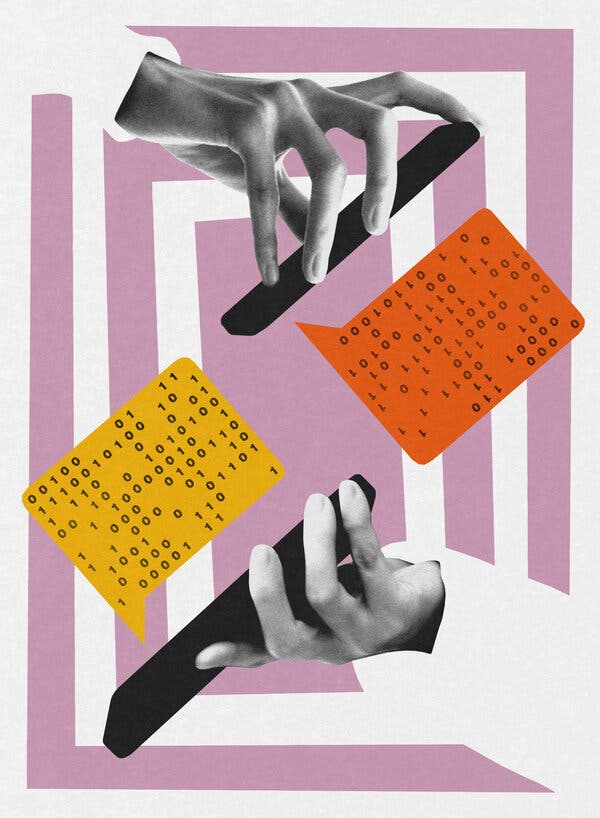
People increasingly use AI to manage tasks. This raises questions about communication when machines predominantly interact.
Photo illustration by Chantal Jahchan
By Callie Holtermann
The AI Job Hunt
Job hunting has evolved. Applicants often use AI chatbots to draft resumes and cover letters. Employers then use AI to sort through these applications. Both sides claim necessity to keep pace with the other. Yet the process feels superficial and depersonalized. Is it truly improving mutual understanding?
AI in Education and Romance
This phenomenon extends beyond job applications. A high school student might use an AI chatbot for essay writing. Meanwhile, a teacher uses AI for grading. Similarly, someone may use a chatbot to craft a witty romantic message, with the recipient responding via their own AI chatbot. In another scenario, an AI assistant might handle arguments with a company’s customer service AI.
One Reddit user humorously noted, “We’ve reached the point where customer support involves two large language models (LLMs) locked in a loop of ‘I understand your concern,’ while humans become passive observers.”
Bot Loops
As people adapt to chatbots, these technologies create complex situations. These are what I term “bot loops” – small cycles created when humans pass their roles to AI.
Potential and Challenges
Some view these AI interactions as potential life simplifiers. It is plausible that AI voice agents might handle tasks like calling government agencies. Although attempts by AI personas to take on human interactions, such as dating, have met mixed results.
Whitney Wolfe Herd, CEO of dating app Bumble, envisions AI personas conducting dates on behalf of users and reporting outcomes. However, experiences like my colleague Eli’s show these concepts face numerous hurdles.