
Amy Sherald was selected to paint the official portrait of Michelle Obama nine years ago. At the time, many in the art community were unfamiliar with Sherald. Today, she is one of America’s most distinguished painters. At 52, Sherald achieved major recognition with three major museum retrospectives last year. However, a separate exhibition last fall at the Smithsonian’s National Portrait Gallery attracted attention for different reasons. Sherald canceled it due to concerns that museum officials might censor a painting under pressure from the Trump administration.
Sherald has faced many challenges, some greater than the potential censorship. Her paintings, primarily depicting Black Americans, present subjects gazing directly at the viewer with a knowing and unapologetic expression. They appear unafraid, surrounded by monochromatic backgrounds or vibrant settings. A notable painting shows a farmer on a spotless John Deere tractor amidst a blue sky and green grass.
Anderson Cooper: In many of your paintings, the subject looks out at the viewer.
Amy Sherald: That’s important. These portraits are not confrontational, but they are present. They engage viewers in an exchange.
Sherald believes her subjects, despite their silent presence, convey significant work simply by meeting the viewer’s gaze. This interaction initiates a dialogue within the viewer.
Her work is featured in prestigious museums and in personal collections, including Anderson Cooper’s. Last summer, Sherald provided a private tour of her show “American Sublime” at the Whitney Museum of American Art, a dream she held for years.
Sherald: I would meditate and visualize myself in this space.
Cooper: How does the reality compare to your vision?
Sherald: It’s exactly like I imagined.
Sherald’s portraits are unique. Instead of traditional names, these real individuals form part of Sherald’s visual storytelling. Her process begins with photographing subjects she is drawn to, often friends, models, or strangers encountered. Their attire, often sourced from thrift stores, creates a narrative.
Among her significant works is the portrait of Breonna Taylor, painted after her tragic death in a police raid. Sherald’s most renowned piece is the portrait of Michelle Obama, titled “Michelle LaVaughn Robinson Obama,” which gained global attention upon unveiling in 2018.
Cooper: Did this work impact your career?
Sherald: Yes.
Reflecting on this painting, Sherald admires the dress’s colors and symbolism, intending it to stand as a significant element in itself.
Before its display at the Whitney, “American Sublime” was showcased at the San Francisco Museum of Modern Art, curated by Sarah Roberts.
Cooper: The experience changes seeing her work in person due to its luminescent quality.
Roberts: The color and majesty are better appreciated in person.
Roberts highlights Sherald’s technical prowess in painting, categorized as American Realism. Her depiction of ordinary American life conveys themes like freedom and individualism while reimagining classical Americana icons to include all narratives.
Cooper: Are all perspectives included?
Roberts: Everyone finds their place on the museum wall.
A transformative moment for Sherald was seeing a painting by Bo Bartlett featuring a Black man. This exposure to representation solidified her ambition to pursue art.
Cooper: What did the exposure to representation spark in you?
Sherald: I wanted to depict Black individuals in art, a clear calling moment.
Despite familial aspirations for Sherald to pursue medicine, she chose art, dedicating years to painting during the day and waiting tables at night. Sherald refused to abandon her passion despite doubts.
Cooper: Did you consider abandoning this pursuit?
Sherald: Yes, but perseverance triumphs over quitters.
A significant health battle arose when Sherald was diagnosed with a rare heart condition, nearly losing her life during an episode that led to a heart transplant from donor Kristin Lin Smith.
Cooper: Does the transplant change your perspective?
Sherald: Initially, yes. Her presence becomes significant during achievements, resulting in marked memories shared on social media.
Her paintings embody Kristin’s spirit alongside Sherald’s own identity.
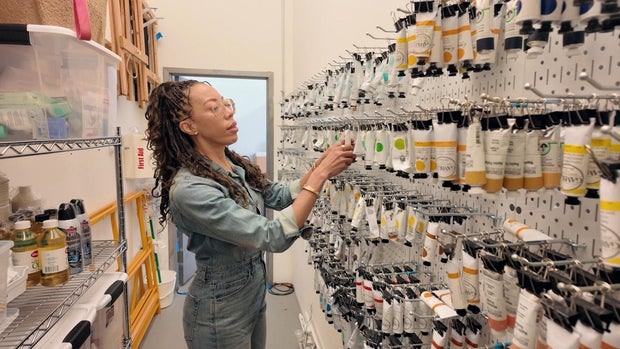
Sherald’s New Jersey studio houses her paint collection, where she meticulously mixes paint for portraits. Her choice to use grayscale reflects introspection on Black representation. The grayscale allows a focus beyond skin color.
Cooper: Would brown skin alter focus?
Sherald: Yes, though phenotype recognition remains. Grayscale offers a new approach.
When Sherald feared painting Brown individuals might marginalize the work, she opted for grayscale for broader conversations alongside renowned painters like Edward Hopper, Andrew Wyeth, and Norman Rockwell.
Cooper: Are these associations fitting?
Sherald: As a Black woman artist, sharing space with these figures validates my vision.
Planning for her canceled Smithsonian exhibition, Sherald emphasized storytelling without censorship on the part of museum officials, who aimed to contextualize a painting featuring a trans individual. Believing such framing would alter her work’s intention, Sherald withdrew, moving “American Sublime” to The Baltimore Museum of Art, later to the High Museum in Atlanta.
Cooper: Does your art align politically?
Sherald: Although intrinsically not political, external influences cast it as such.
Central to Sherald’s portrayal is her sense of patriotism affirming lifelong involvement in America’s foundation.
Cooper: Is the work patriotic?
Sherald: Certainly. Black experience epitomizes American identity, defining its essence.
Produced by Graham Messick. Associate producer Alex Ortiz informs the narrative. Edited by Michael Mongulla for accurate representation.