
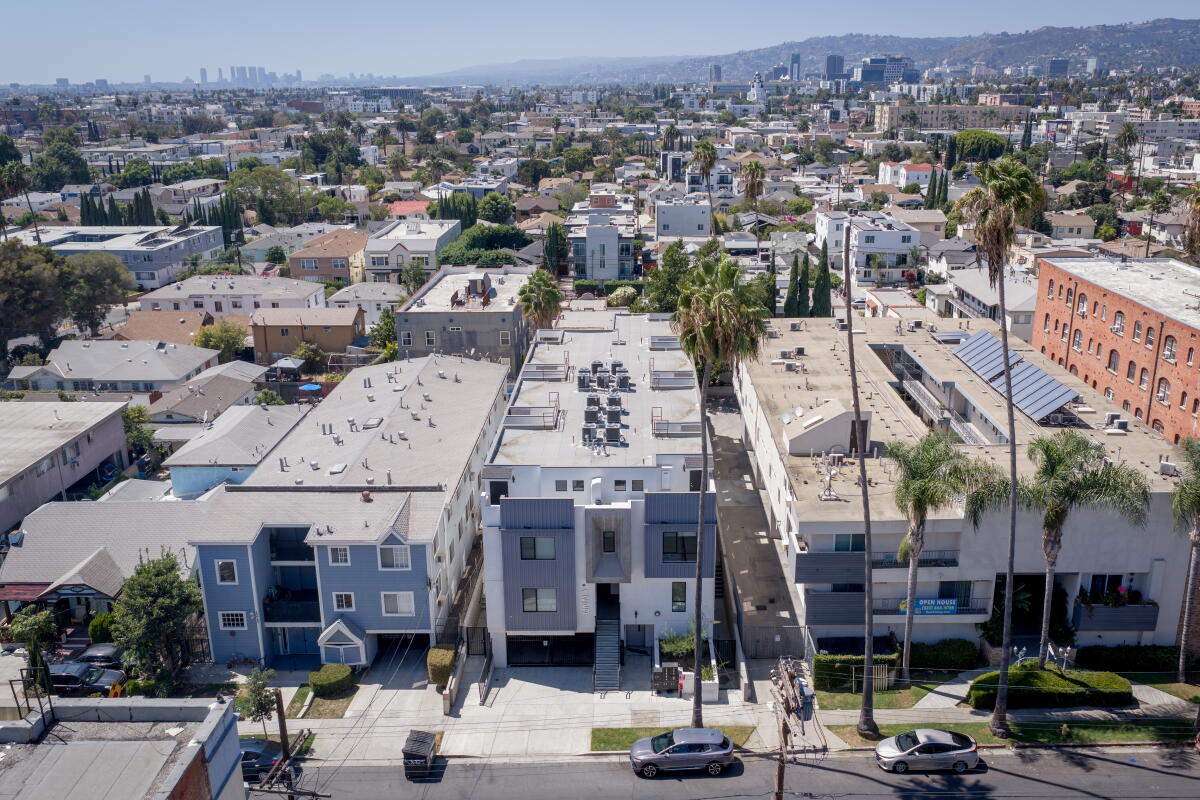
In 2021, developer Paul Schon sold a 14-unit apartment building in Hollywood for $6.5 million. This year, he bought it back for $4.75 million, illustrating the drastic changes in Los Angeles’ multifamily market over recent years.
A 30% drop in half a decade is surprising, but it’s now common. Commercial real estate firm Kidder Mathews reported that the average sale price per unit in Los Angeles County fell from $397,289 in 2022 to $280,591 in 2026.
Los Angeles faces a housing shortage. The state is urging the city to build more homes, and Mayor Karen Bass has introduced a faster permitting process. Despite these efforts, Schon and many developers in L.A. argue that new apartment construction is unfeasible at present. Costs don’t align. Taxes erode profits. Developers prefer smaller, safer projects, such as ADUs and townhouses, instead of larger, denser constructions.
Rents dropped earlier this year to a four-year low, but decades of underbuilding and pent-up demand keep housing expensive for renters and unreachable for prospective buyers.
“People are scared to build in L.A. right now,” Schon said. “All my developer colleagues and friends are sidelined because new development doesn’t make sense.”
Construction has slowed overall. Kidder Mathews notes a near 9% decrease in new apartment units completed in L.A. County during the first half of the year, compared to the previous year. The number of units under construction also fell by about 15%.
Darin Beebower, executive vice president at Kidder Mathews, stated, “Developers I speak to are ‘pencils down,’ and have been for some time.”
Mayor Bass has passed directives to aid developers, including Executive Directive 1, fast-tracking homeless shelters and affordable housing projects and accelerating the permitting process.
“In the face of a growing affordability crisis, Mayor Bass is focused on slashing red tape and removing bureaucratic barriers that have stalled housing production,” said Bass’s spokesperson, Paige Sterling.
Developers cite several reasons for the struggle to build housing in L.A. despite high demand. Rising interest rates, jumping from 2% to 7%, increase the cost of borrowing money for projects.
Schon pointed out that pandemic-era policies, such as rent freezes and eviction moratoriums, flattened revenues. Though expired, their effects linger alongside rising costs.
Another obstacle is Measure ULA, a tax passed by voters in 2022, imposing a 4% to 5.5% tax on property sales above $5.4 million.
“Subtracting 4 to 5% from the sale price impacts profits significantly,” Schon said, affecting investors’ interest.
The resulting situation means less housing development. Developer Yoni Chriqui remarked that builders are choosing smaller projects to avoid the mansion tax threshold.
Chriqui has shifted focus to single-family projects, citing increased expenses and stable rent revenue as deterrents to apartment building.
Permit costs have surged from 10-12% of a budget 15 years ago to 20-25% now, with park fees for multifamily developers climbing to $8,929 per unit.
Though density incentives exist, Chriqui and Schon say they aren’t enough to make large projects viable.
Despite SB 79 enabling denser, taller projects near transit, no proposals have emerged under this bill in L.A.
Recent property sales have seen significant losses, as Paul Darrow, managing director at Walker & Dunlop, noted concerning a Hollywood apartment sale.
Darrow explained the disparity in demand across neighborhoods due to crime and homelessness versus trendy areas.
“Every free fall has a floor. Some buyers see value drops as a chance to re-enter the market,” Darrow said.
For Schon, repurchasing the Hollywood property is a risky but hopeful venture.
“I’m excited but nervous. I hope L.A. has bottomed out and there’s upside now,” he stated.
Meanwhile, parcels capable of housing hundreds remain underutilized. Chriqui plans 10 homes instead of 40 to 50 units on his 14,000-square-foot lot.
He holds plans for a 56-unit project that isn’t financially feasible as its value dropped from $6 million to $3 million.
The lot remains a parking area.