
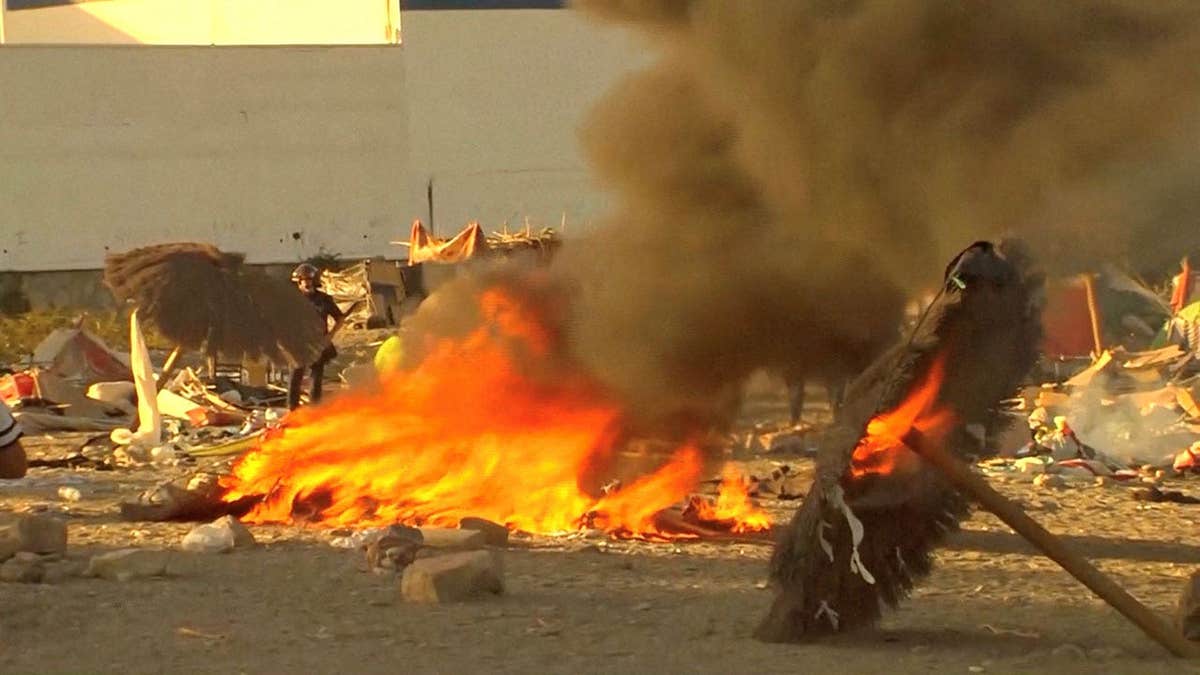
Residents of Ceuta, a Spanish enclave in North Africa, have torn down and burned temporary migrant shelters as tensions escalate due to a large influx of migrants from Morocco. Prime Minister Pedro Sánchez accused Russian and Israeli-linked networks of spreading disinformation that fueled the crisis.
Last week, demonstrators carrying Spanish flags moved toward the beachside camps of migrants, destroying shelters and setting fires. Police worked to separate the protesters from the migrants. Protesters chanted “Invaders, expulsion” as they approached the beaches, reported by EFE.
The unrest follows an unprecedented surge on July 30 and 31, with over 72,000 migrants crossing irregularly from Morocco into Ceuta, one of the European Union’s two land borders with Africa. Ceuta authorities reported at least 100 deaths during the crossing. As of Monday, roughly 5,000 migrants remained in the enclave.
Sánchez linked the massive crossing to a foreign-backed disinformation campaign. Misleading videos and posts on Instagram, TikTok, and other social-media platforms falsely suggested that sea-arrived migrants would be permitted to stay in Spain.
Sánchez, speaking to radio station SER, cited research by the European External Action Service regarding the involvement of Russian and Israeli networks in spreading disinformation, alongside far-right networks. Russia and Israel rejected his accusations.
Israeli Foreign Minister Gideon Sa’ar accused Sánchez of diverting attention from domestic issues, while Kremlin spokesman Dmitry Peskov denied Russia’s involvement in the crisis.
Sánchez also denied allegations that Morocco deliberately facilitated the border surge, a claim supported by some Spanish opposition parties and human-rights organizations.
Disinformation about the Ceuta crossing had been circulating before Sánchez’s accusations. An open-source investigation by Golden Owl Intelligence tracked misleading interpretations of Spanish immigration law across various platforms.
After Spain’s Supreme Court ruling on July 8, which restricted the immediate return of intercepted migrants, simplified accounts spread online, suggesting those reaching Spanish territory could stay. Confusion also surrounded Spain’s plan to regularize undocumented migrants.
Zineb Riboua, a research fellow at the Hudson Institute, highlighted that Islamist movements sought to exploit the crisis politically, amplifying unrest and portraying Europe as attractive. These movements were critical of Morocco’s ties with Israel and the U.S.
The crisis affected other countries too. Italy extended for 15 days its suspension of Schengen free-movement arrangements with Spain, initially imposed on July 31 due to the mass influx.
Nile Gardiner of the Heritage Foundation warned that Ceuta could become a pivotal point in the European Union’s unraveling, suggesting that breaking down Schengen could disrupt the European project.