
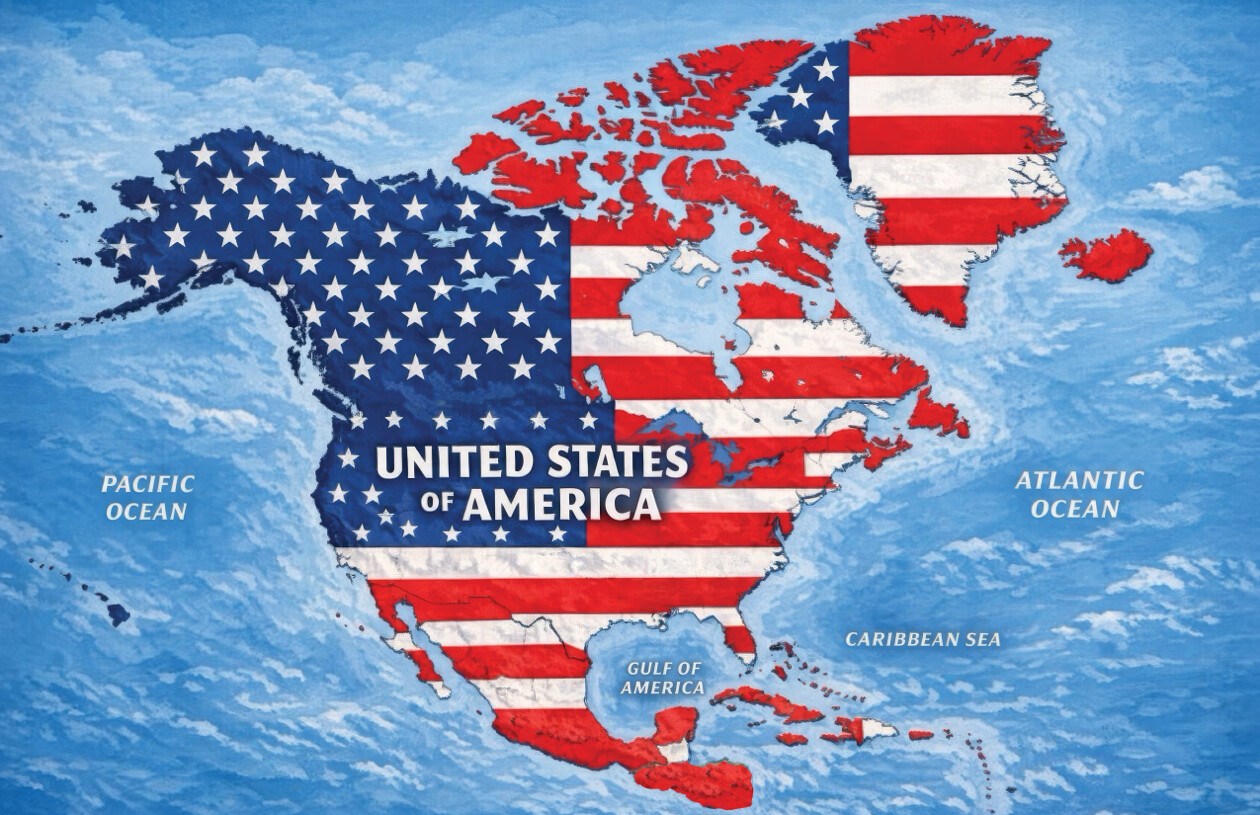
President Donald Trump sparked controversy with a map posted on Truth Social that appears to claim all of North America as part of the United States. This image, interpreted by many as a bold message about U.S. hemispheric dominance under the ‘Donroe Doctrine’, follows Trump’s escalation of a trade war with Canada. The tensions have practical implications beyond mere economic disagreements.
Trump has referred to Canada as the 51st state in casual remarks and has shown interest in controlling Cuba, Greenland, Mexico, and the Panama Canal. His administration has renamed the Gulf of Mexico to the Gulf of America and Lake Ontario to Lake America in official documents.
These moves underscore several territorial disputes with Canada that existed long before Trump but remain unresolved today. According to Rob Huebert of the University of Calgary’s Center for Military Security and Strategic Studies, Trump’s policies pose risks to longstanding U.S.-Canada unity. Canadians are unsure of Trump’s objectives with his disruptive policies.
‘It is unthinkable that the unity achieved between the U.S. and Canada throughout history could be thoughtlessly discarded,’ Huebert warned.
The Canadian government is focusing on boosting defense unilaterally in response. However, Huebert assures that Canada would respond robustly to any territorial challenges.
Relations Ice Over in the Arctic
An unresolved Arctic dispute involves the Beaufort Sea, rich in oil and gas resources. Canada and the U.S. have a long-standing disagreement over the maritime boundary north of Alaska and Canada’s territories. This dispute, based on different interpretations of an 1825 treaty, involves potential claims on the continental shelf.
In late 2024, a bilateral task force was formed to address these issues, but progress has stalled. The Northwest Passage also causes friction, with Canada claiming exclusive rights while the U.S. views it as international waters.
Heightened interest from Russia and China in Arctic resources adds complexity to this dispute, particularly with Trump’s aggressive posture towards Greenland.
Adam Lajeunesse from St. Francis Xavier University warned that deteriorating Arctic cooperation could harm U.S. military access. He noted the risk of enabling Chinese and Russian usage of the passage if the U.S. prevails in asserting it as international waters.
‘Winning this dispute would mean nothing but granting access to others,’ Lajeunesse said.
Problems Drawing the Line
The boundary dispute extends to Machias Seal Island near the Bay of Fundy, claimed by both countries. The Canadian Coast Guard operates a lighthouse there, but the U.S. cites historical treaties to assert possession.
Further disputes involve Pacific waters, including Dixon Entrance and the Strait of Juan de Fuca. Though resolved historically, Trump’s policies could revive tensions.
Michael Byers, a University of British Columbia expert, sees the disputes as manageable but acknowledged active disagreements in the Arctic.
‘No good reason exists to revive these disputes as they’re well-managed,’ Byers remarked.
Neighbors React to Trump Threats
Canadian Prime Minister Mark Carney urged unity against Trump’s territorial assertions. Canada imposed tariffs on $20 billion of U.S. goods in retaliation.
‘Canada is a nation forged in adversity,’ Carney proclaimed in a video message, emphasizing Canada’s history of resilience against U.S. aggression.
Trump retaliated with further economic threats concerning Canadian aircraft manufacturing.
Carney remains firm, dismissing Trump’s rhetoric as unconstructive.
Mexico, Iceland, and Denmark reacted strongly against the territorial assertions shown in Trump’s map. Leaders reaffirmed their sovereignty and independence.