
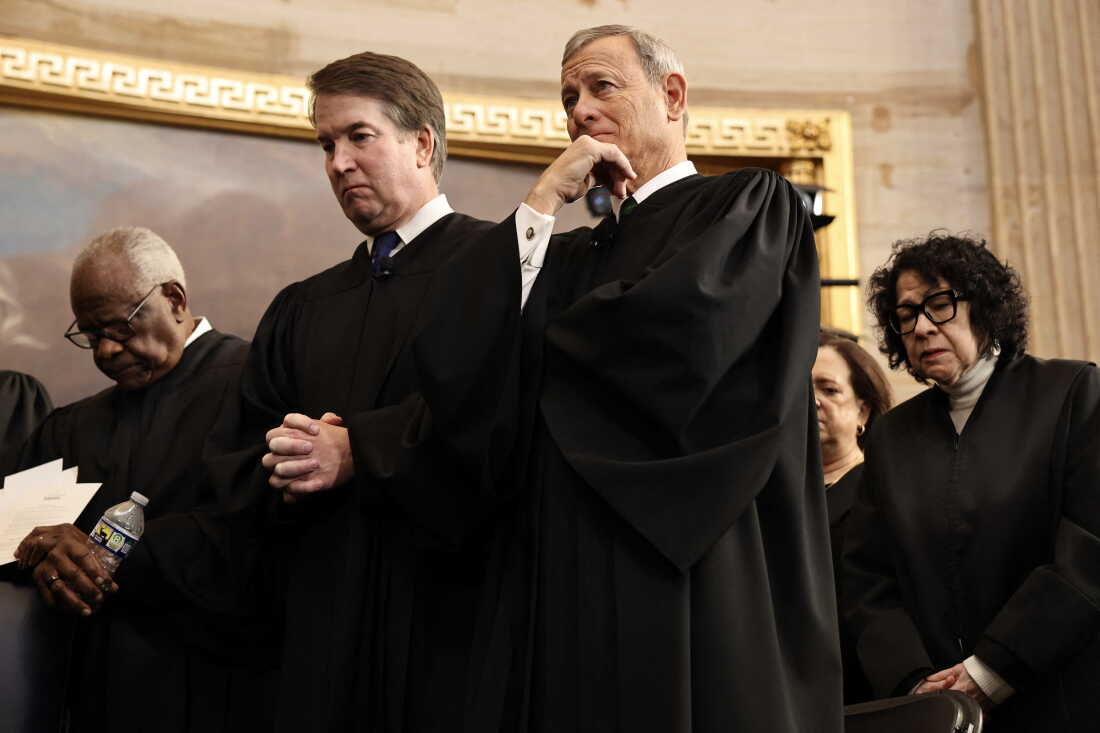
From left to right, Supreme Court Justices Clarence Thomas and Brett Kavanaugh, Chief Justice John Roberts, and Justice Sonia Sotomayor bow their heads during presidential inauguration ceremonies on January 20, 2025, in Washington, D.C. This moment captured by Chip Somodevilla for AFP via Getty Images reflects the solemnity of the occasion.
In recent years, arguments at the Supreme Court have become lengthier. Sessions once lasting an hour now often stretch much longer, testing the patience of some justices. Chief Justice John Roberts is contemplating changes as the new term begins in October. However, finding a simple solution is challenging.
The Supreme Court traditionally adhered to strict oral arguments, typically completing cases in 60 minutes. The late Chief Justice William Rehnquist enforced this rule rigorously, often cutting off arguments when time expired. Notable figures, like Harvard Law professor Laurence Tribe and Brett Kavanaugh, experienced this enforcement firsthand. Despite the traditional protocol, practices have evolved.
Adam Feldman, who studies the Supreme Court through a Substack newsletter about the justices and data, notes a change. “The arguments are definitely longer than they used to be,” he says. Sessions called for 60 minutes now extend to 90 minutes or more.
The COVID-19 pandemic forced adaptations. The format of oral arguments changed, allowing each advocate brief uninterrupted time to present. Each justice then asked questions before a more open discussion. Feldman explains, “The purpose during COVID was you couldn’t see each other telephonically, and so there had to be some ordering or it would have been really messy.”
Transparency in Arguments
Oral arguments hold significant importance for the court, especially amid declining public opinion. Tonja Jacobi, a law professor at Emory University, highlights their value: “Oral argument is the one open part, the one transparent part of the Supreme Court’s decision-making process, so it’s very important to have it available to the public, even if the public mostly doesn’t listen.”
Some changes to arguments receive broad approval. Justice Clarence Thomas, previously quiet, now speaks more frequently due to seniority. Jacobi observes that format changes, such as giving each justice dedicated time, address her research findings that male justices and advocates often interrupted female justices. Nonetheless, the rate of interruptions has not improved. Justices often use their time to address each other, with polarization limiting persuasion opportunities.
Justice Ketanji Brown Jackson, the newest court member, speaks most frequently, followed by Justice Sonia Sotomayor. Jacobi offers insight: “Essentially, I think when you’re expecting to be on the losing side of an argument, you do more talking to try and persuade people to your side.” With six conservative justices forming a coalition, confidence levels may vary, reducing the need for persuasion.
Roberts Contemplates Adjustments
Some justices find the longer arguments challenging. Chief Justice Roberts acknowledged the issue during a summer event, stating that the arguments have become too lengthy and he is considering ways to manage them.
Former acting Solicitor General Jeff Wall discusses the difficulty: “I don’t know what you do,” he remarked. “It’s like when I’m on a conference call and I want someone to stop talking. There’s no easy way to get people to talk less when you would like them to.” Feldman suggests that time management is evolving, with Roberts working on potential solutions behind the scenes.
Jacobi points out that notably significant cases might require more time than the typical 90-minute session. She adds a broader perspective: “Now I should note that in other jurisdictions such as Australia, my home country, we measure oral arguments in days, not minutes, so it could be worse.”
Any adjustments in the format will become apparent on October 5 when the court commences its new term.