
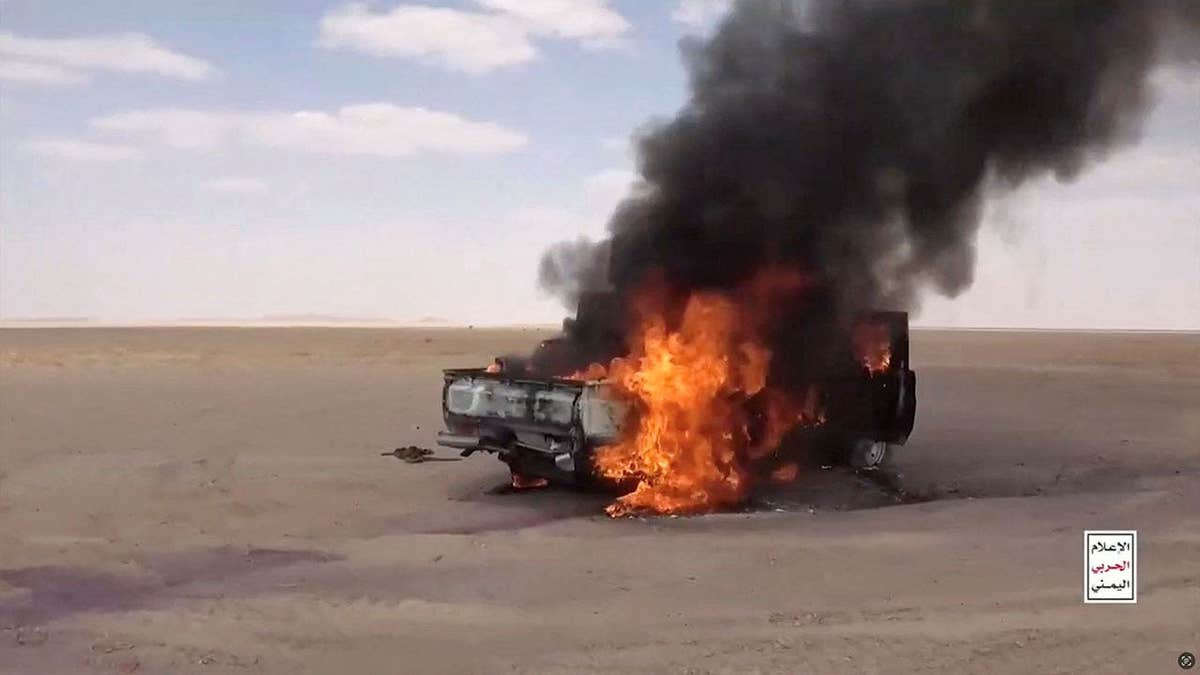
Iran-backed Houthi forces recently seized Yemen’s strategic port city of Mocha, elevating concerns over global trade routes. Their advance towards positions overlooking the Bab el-Mandeb Strait opens a new front for international commerce, especially as shipping through the Strait of Hormuz faces severe restrictions.
This situation threatens the southern entrance to the Red Sea at a time when Saudi Arabia increasingly relies on it to bypass Hormuz. The move applies pressure on vital shipping lanes on both sides of the Arabian Peninsula, increasing the risk of further disruptions to oil and commerce traffic through an essential global trade chokepoint.
“Now you have Iran on one side of the Arabian Peninsula controlling Hormuz, and now the Houthis controlling Bab el-Mandeb on the other side,” explained Hisham Al-Omeisy, senior Yemen adviser at the European Institute of Peace. “This situation is going to drive prices—oil prices, goods, and everything else—up exponentially.”
On the background, a senior administration official expressed that the United States focuses on maintaining core national security interests, such as ensuring the freedom of navigation in the Red Sea, while enabling regional allies to manage and resolve security challenges. The U.S. continues dialogue with Saudi Arabia and the Republic of Yemen Government regarding regional stability.
Yemeni government sources revealed that the Houthis captured Mocha and reached the Hanish Islands. Consequently, Saudi-backed Yemeni government forces retreated southward towards Dhubab, positioned directly on Bab el-Mandeb opposite the strategic island of Perim. Control over Dhubab and Perim would significantly enhance strength over the strait, according to Yemeni government sources.
Bab el-Mandeb, spanning approximately 18 miles at its narrowest point, connects the Indian Ocean and Gulf of Aden with the Red Sea and further north, the Suez Canal. This crucial artery facilitates the movement of goods between Asia and Europe, along with energy shipments. Its significance grows amid ongoing conflicts involving Iran.
The U.S. Energy Information Administration reported that crude oil and petroleum liquids through Bab el-Mandeb averaged 8.1 million barrels per day during the second quarter of 2026, marking an increase from 5.4 million barrels daily in the final quarter of 2025. Meanwhile, shipments through Hormuz decreased from 21.6 million barrels per day to 4.9 million. The EIA noted increased activity at Bab el-Mandeb partly due to Saudi Arabia rerouting crude via the East-West pipeline to the Red Sea port of Yanbu to circumvent Hormuz.
Al-Omeisy emphasized that the threat expands beyond geographical gains, due to retreating Yemeni government forces leaving behind military supplies.
“People are focused on taking Mocha and those outposts on the Red Sea,” he stated. “The concern lies in the military aspects, specifically the equipment, ammunition, vehicles, drones found at those military camps, which Houthis can now use against government forces elsewhere.”
Reports highlighted Iran’s role in aiding the Houthi advance, with Yemeni government, Iranian, and regional sources confirming the involvement of Iranian arms and guidance from Iran’s Revolutionary Guards. Furthermore, two Iranian sources reported that Tehran instructed the Houthis to intensify attacks on Saudi Arabia, promising enhanced funding, weapons, and senior officers. Despite this, Iran has publicly denied directing Houthi operations.
Meanwhile, conflict-monitoring organization ACLED reported a significant rise in tensions between the Houthis and Saudi-backed factions since hostilities reignited in mid-July. ACLED documented at least 276 fatalities between Sept. 3 and Sept. 7, as clashes spread across al-Dali, al-Bayda, Marib, Shabwa, al-Jawf, al-Hudayda, and Taizz.
Sherwan Hindreen Ali, ACLED’s Middle East research manager, noted intensified fighting along the Red Sea coast as each side vies for strategic control over territory important to Bab el-Mandeb.
“The battles will concentrate on the Red Sea coast fronts in al-Hudaydah and Taizz, where both Houthis and the Saudi Arabia/IRG have stakes in claiming the entirety of the territory for effective control over Bab el-Mandab,” Ali expressed.
Saudi Arabia has deepened its involvement; Ali mentioned that Saudi forces launched at least 15 strikes against the Houthis between Sept. 3 and Sept. 7. This marked the highest number of strikes since Riyadh resumed military action against the Houthis in July.
In a retaliatory move, the Houthis executed their largest series of direct attacks on Saudi territory since March 2022, launching numerous drones and ballistic missiles towards Abha, Jizan, Najran, and Khamis Mushait. Ali mentioned that these strikes resulted in 73 injuries.
The ongoing conflict now serves as an early examination for the newly formed joint defense agreement among Saudi Arabia, Pakistan, and Turkey.
“The Houthis efficiently exploit divisions and delays, swiftly advancing on the ground to establish a position while the international community debates intervention merits,” explained Al-Omeisy.
The escalation raises questions about Saudi Arabia’s recently formalized defense agreement with Pakistan and Turkey. The pact, signed in Mecca, declares an armed attack against one member as an attack against all three. However, following Houthi assaults on Saudi cities and energy facilities, Pakistan clarified on Thursday that no military response under the agreement is presently under discussion.
Houthis have asserted safe international navigation through the Red Sea and Bab el-Mandeb, maintaining Saudi vessels’ blockade.
“Reversing the Houthis’ territorial gains is becoming increasingly challenging,” Al-Omeisy cautioned. “They are adept at fortifying positions with substantial reinforcements, making it extremely difficult to dislodge them.”
Oil markets have already reacted to the regional threat. On Thursday, Brent crude surged more than 5%, reaching $106.60 a barrel by late morning, while U.S. crude surpassed $100 for the first time since May.
Efrat (Effie) Lachter, a Fox News Digital reporter, brings more than 15 years of experience in covering conflicts, global affairs, human rights, and political accountability. With expertise, she has directed and produced over 200 documentary segments in more than 40 countries. Her work spans various crisis zones in the Middle East, Europe, Asia, and Africa, uncovering human trafficking networks, ISIS underground prisons, and the war in Ukraine. Lachter’s senior political figures and world leaders interviews include testimonies from Russia post-war. Lachter secured the 2022 Peres Center for Peace Award and was a Knight-Wallace Journalism Fellow. She also claimed two Rockower Awards for excellence in reporting.