
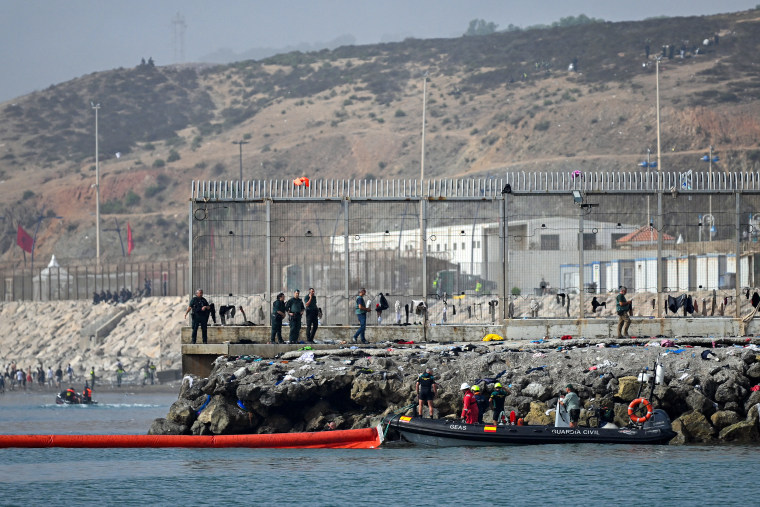
Ceuta, a Spanish territory in North Africa, faced a significant breach of its sea border with Morocco when tens of thousands of migrants crossed it. A containment barrier of 500 meters is being installed by Spain to prevent further crossings. This move follows a massive influx earlier this week, with reported numbers ranging between 50,000 to 60,000 migrants.
Fatalities have been reported among those attempting to cross. Official figures state that 67 individuals have died, some drowning, while others perished in a stampede. Ceuta’s authorities claim the death toll is at 86.
Spanish Prime Minister Pedro Sánchez criticized certain European Union leaders for their reaction to the events. He noted that calls to suspend Spain from the Schengen zone were based on misleading information or political motives. Such actions, Sánchez argued, are influenced by prejudice.
“We are relentless against those who break the law,” said Spanish Interior Minister Fernando Grande-Marlaska, emphasizing a strict stance on unauthorized crossings.
Marlaska defended Morocco, rejecting claims that it posed a threat to Ceuta. He highlighted cooperation between Spain and Morocco in addressing the crisis.
An official report noted the swift action taken to normalize the situation within 24 hours thanks to collaboration with Morocco. Spanish authorities stress Morocco’s reliability as a partner.
A Spanish Guardia Civil boat deployed a pneumatic barrier to reinforce security along the Ceuta-Morocco border.
European Union’s Call for Coordinated Action
The leaders of 22 EU countries stressed the need for a unified response. A letter, released by Denmark’s prime minister, urged EU’s Irish presidency to organize a videoconference with interior ministers.
The correspondence emphasized preventing illegal entries into the EU and warned about potential misperceptions that might result in more attempts.
Among those who signed were leaders from diverse nations like Italy, Germany, and Sweden.
Sánchez also called for EU collaboration, urging unity among members in upholding border security.
Italy, led by Premier Giorgia Meloni, threatened to suspend agreements with Spain due to these incidents, resulting in tighter controls for arrivals by air and sea.
“The EU cannot afford polarizing reactions,” Sánchez said, highlighting unity.
Return of Migrants to Morocco
Recently, migrants began streaming back into Morocco after experiencing hardships in Ceuta. The returnees described degrading conditions on the Spanish side.
A significant number used an informal entry point to return freely, observed by Moroccan forces. Many were Moroccan, while others were from sub-Saharan Africa.
Those returning reported challenging conditions, including lack of food and tense shelter situations.
Migrants like Ouail Lamzeiz recounted days without food in Ceuta, leading to his voluntary return. Meanwhile, Salah Eddine El Arrage alleged mistreatment by Spanish police.
Migrants often slept in forests and grappled for food, highlighting the severe conditions.
Othmane El Merzoug sought financial help from relatives to fund his journey home.
The road connecting Fnideq to Ceuta’s border showed signs of unrest, with burned vehicles and police barricades guiding traffic.
Juan Jesús Vivas, Ceuta’s President, expressed that the border incidents disrupted city life but was optimistic about returning stability.
In Tangier, Morocco, people were seen returning from Ceuta, visibly exhausted. Migrants like Abdalah shared their struggles in attempting crossings.
Despite the challenges, some like Mohamed Hatri remained steadfast in staying in Ceuta, even with insufficient resources.