
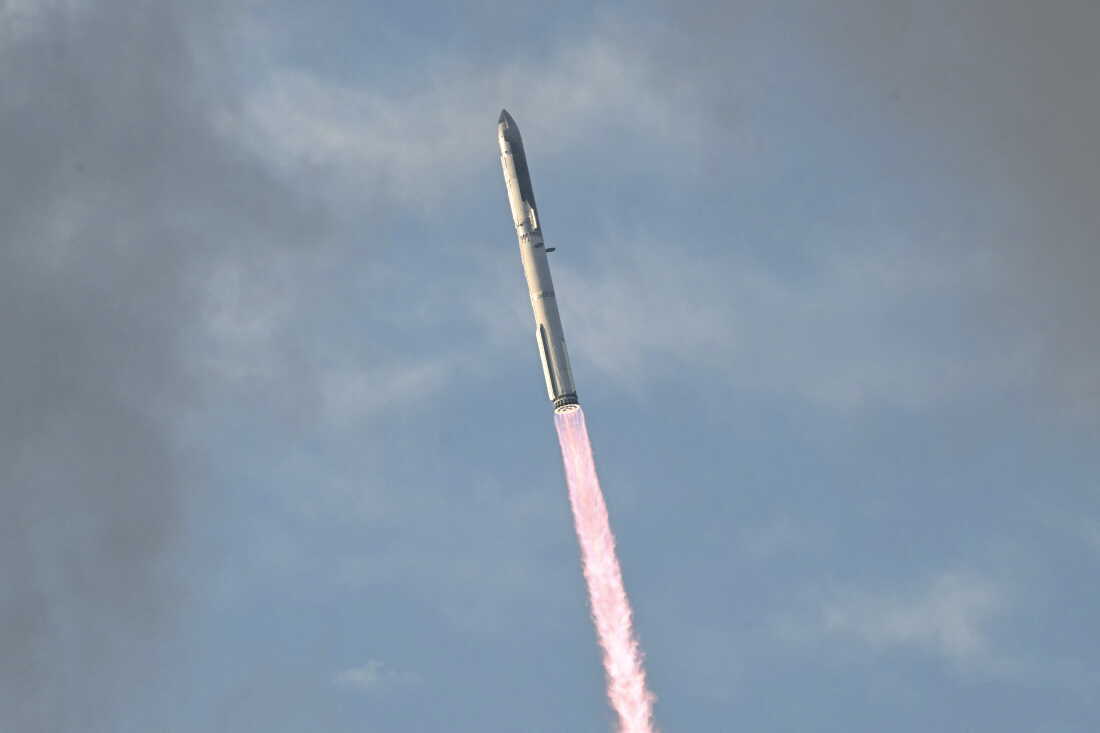
SpaceX launched its Starship spacecraft from the company’s Starbase facility at Boca Chica Beach, Texas, embarking on a critical test flight that successfully sent the 171-foot-tall vehicle into orbit for the first time.
At 7:48 am CT, the Super Heavy booster ignited its 33 rocket engines, propelling the spacecraft on its 14th flight. Two-and-a-half minutes post-launch, Starship separated from the booster, continuing its journey into space. Although one of Starship’s six engines failed during ascent, SpaceX assessed the situation and decided the spacecraft could safely continue to orbit. Approximately 22 minutes into the flight, the team confirmed the decision.
Designed for reusability, the Super Heavy booster typically returns to its launch site where it is caught by the launch tower, but on this occasion, it simulated a landing offshore in the Gulf of Mexico. The flight offered SpaceX an opportunity to test upgrades to the booster’s software and hardware.
The mission, with no crew aboard, planned a 10-hour flight trajectory, including about six orbits around Earth at an altitude of roughly 170 miles. Unlike its previous suborbital flights, Starship 14 aimed to reach orbital speeds of around 17,500 mph. The mission’s launch strategy included options allowing Starship to abort its orbital path and safely return to Earth if necessary.
During the flight, SpaceX deployed 26 Starlink V3 satellites as part of its extensive constellation, offering global broadband access. While traditionally launched using Falcon 9 rockets from Florida or California, SpaceX had announced the last Florida mission last month and plans to utilize Starship from Florida’s Space Coast moving forward.
If all proceeded as planned, Starship’s journey concluded with a splashdown in the Pacific Ocean off Chile’s coast, marking a step towards SpaceX’s goal of spacecraft recoverability and reusability. Key systems, such as the heat shield, underwent testing. Three Starlink satellites equipped with cameras aimed to gather data on Starship’s heat shield, crucial for surviving re-entry.
Starship represents a significant aspect of SpaceX’s growth strategy, notably able to launch the larger V3 Starlink satellites. In FEC filings preceding SpaceX’s June IPO, the company highlighted Starship’s integral role, stating any development delays or failures would impact its growth objectives.
Starship also plays a pivotal role in NASA’s moon mission plans. Selected by NASA as a human landing system, Starship will transport astronauts to the lunar surface for future Artemis missions. NASA plans to test docking its Orion space capsule with Starship, complemented by another lander from Blue Origin during Artemis III, slated for late next year.
Looking ahead, SpaceX announced intentions to construct a vast facility in Louisiana, with a $100 billion investment including plans for numerous launch pads. The ambitious development aims to commence Starship launches from Starbase, Louisiana, starting in 2029.