
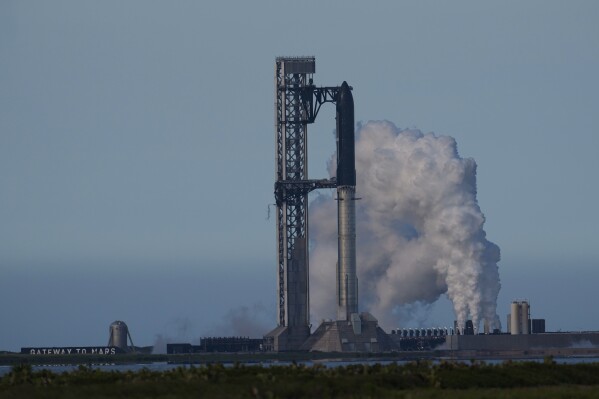
SpaceX launched its most formidable Starship on a test flight Friday, marking a significant step in NASA’s plans to land astronauts on the moon. The updated rocket, introduced just days after CEO Elon Musk shared news of SpaceX going public, departed from Texas. It carried 20 mock Starlink satellites, released mid-flight, as the spacecraft traveled halfway across the globe. Even with some engine issues, the spacecraft reached the Indian Ocean, where it ended through a fiery impact. SpaceX anticipated this outcome.
Musk praised the launch and landing, declaring, “You scored a goal for humanity,” in a message to his team via X. This launch marked the 12th test of the rocket. Musk envisions it as a vehicle to eventually take humans to Mars. However, its initial destination is the moon, in line with NASA’s Artemis program. NASA Administrator Jared Isaacman was present for the launch and remarked that Starship’s progress brings it nearer to lunar missions.
The last earlier iteration of Starship ascended in October. SpaceX’s new third-generation Starship, termed V3, launched from a fresh pad at Starbase, near the Mexican border. A minor issue had postponed the initial launch attempt on Thursday. SpaceX aimed to avoid repeating incidents where previous flights exploded in midair over the Atlantic. This time, the spacecraft descended into the Indian Ocean under controlled conditions, toppling over before ignition. Although the launch was largely successful, some booster engines did not fire as intended as it returned. Nonetheless, the spacecraft ascended 120 miles eastward using fewer engines.
Two modified Starlink satellites offered brief footage of the spacecraft — a first of its kind. Standing at 407 feet, this version surpasses earlier Starships and boasts more engine thrust. The redesigned booster includes fewer yet larger grid fins for improved steering post-liftoff, alongside a more extensive fuel line to feed the 33 powerful engines. This line matches the size of SpaceX’s Falcon 9 booster. The stainless steel ship is equipped with more cameras, enhanced navigation, and docking cones for rendezvous missions.
Starship aims to be completely reusable. Mechanical arms should eventually capture the returning rocket stages at launch pads, but this trial did not involve any recovery. The first-stage booster concluded over the Gulf of Mexico, while the spacecraft and its satellite payloads ended in the Indian Ocean.
NASA has invested billions in SpaceX and Blue Origin to develop lunar landers for astronauts in the Artemis program. Both firms are eager to lead. Starship has approached space’s edge multiple times, but Blue Origin’s prototype is yet to fly, though preparations for a launch are underway.
Following April’s successful lunar flyaround, NASA plans an Earth orbit docking trial next year as part of Artemis III. Astronauts will attempt to dock their Orion capsule with Starship, Blue Moon, or both, with a potential lunar landing during the Artemis IV mission by 2028. This will be NASA’s first crewed lunar landing since Apollo 17 in 1972, focusing on establishing a base near the lunar south pole.
SpaceX has begun accepting bookings for private moon and Mars flights on Starship. California businessman Dennis Tito, the first space tourist, and his wife booked a moon flyby over three years ago. Timing remains uncertain. Recently, Chun Wang, a Chinese-born bitcoin investor, announced plans to fly to Mars on Starship’s inaugural interplanetary mission. Previously, he led a crew on a SpaceX polar flight, orbiting above both poles. Details on his Mars mission remain undisclosed.
The Associated Press Health and Science Department reports, thanks to support from the Howard Hughes Medical Institute and the Robert Wood Johnson Foundation. Content responsibility lies solely with the AP.