
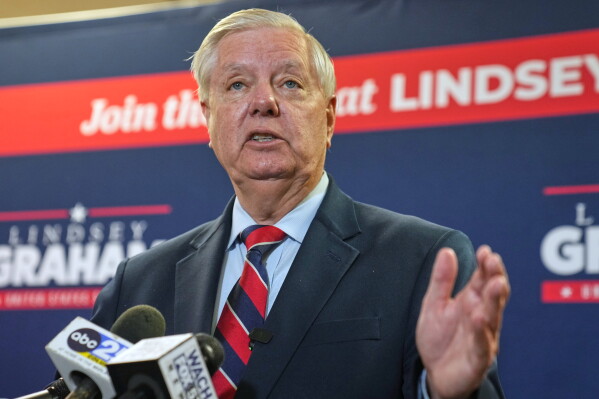
The death of Sen. Lindsey Graham marks a significant change in South Carolina politics, a state already experiencing disruption this year. Graham, known as a key ally of former President Donald Trump, was expected to secure a fifth term with ease.
Governor’s Dilemma
Gov. Henry McMaster now holds the responsibility of appointing a temporary replacement for Graham. This appointment will serve until January. Meanwhile, the state is arranging a special primary to select a Republican candidate for the upcoming general election.
Intense Competition
The available Senate seat has sparked competition among South Carolina’s conservatives eager to advance politically. Recently, Republicans concluded a contentious race to choose a successor for McMaster, who is concluding his second term.
State Attorney General Alan Wilson secured the nomination, defeating Lt. Gov. Pamela Evette, Rep. Nancy Mace, and Ralph Norman. These figures now turn their attention to Graham’s vacant seat.
Special Primary Process
Per South Carolina law, a special primary’s filing period opens on the second Tuesday after a candidate’s death, or July 21. The primary takes place the following second Tuesday, or Aug. 11, with a runoff scheduled two weeks after, or Aug. 25. The new nominee would then have limited time to campaign ahead of the Nov. 3 general election.
This timeline poses challenges with federal law, requiring military and overseas ballots 45 days before an election. Federal Election Commission consultations are ongoing regarding this process.
Potential Replacements
Graham’s sudden death, attributed to an aortic dissection, has stirred speculation about his successor. The appointee from McMaster could lead the special primary, or serve temporarily as a placeholder.
Evette emerges as a possible candidate, receiving statewide encouragement and believing her prospects in the primary are strong. Meanwhile, Rep. Joe Wilson has expressed his intent to stay in the House, given the Republican’s narrow majority.
Rep. Nancy Mace, not seeking House reelection, is considering running. Additionally, Rep. Russell Fry, a prominent Trump supporter, is another potential contender.
Impact on the General Election
In South Carolina, Republican candidates traditionally dominate Senate races. Graham’s 2020 victory over Democrat Jaime Harrison exemplified this trend, culminating in a 10 percentage-point victory.
This November, Charleston pediatrician Annie Andrews represents the Democratic side, having secured over $8 million in campaign funding, with nearly $3 million remaining by May’s end. Graham’s reelection efforts raised $6 million, with over $4 million remaining.
Andrews called for bipartisan unity following Graham’s death, while Harrison acknowledged their political disputes but expressed mutual respect.
Shifting Influence
Graham’s absence leaves a significant gap in the Senate, where seniority often equates to power. Sen. Tim Scott, his junior colleague since 2012, lacks comparable tenure. Previous South Carolina senators such as Fritz Hollings and Strom Thurmond served lengthy terms.
Scott, who co-led Graham’s reelection campaign, shared his sentiments, stating Graham’s role as ‘irreplaceable’ and reflecting on the loss of a friend.
Associated Press writer Fatima Hussein contributed to this report.
Kinnard can be reached at http://x.com/MegKinnardAP.