
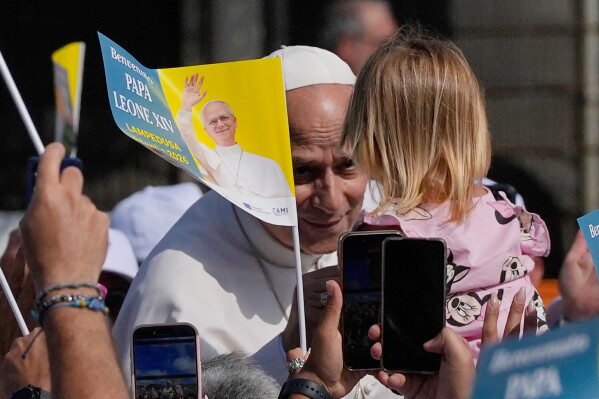
Pope Leo XIV arrived in Castel Gandolfo on Sunday, commencing a six-week vacation at the papal summer retreat. This marks the return of a pope to the town after Pope Francis opted not to visit during his 12-year papacy. As Pope Leo greeted enthusiastic supporters lining the main road, he expressed his intent for a brief rest period from the balcony of the villa where he will stay.
“I hope everyone can have some vacation time to restore the body and spirit,” Leo remarked before departing the Vatican during his noon prayer. As a 69-year-old Chicago native, Leo is revitalizing the tradition of escaping the Vatican’s summer heat for the cooler climate of Castel Gandolfo, perched above Lake Alban. Historically favored by Roman rulers since the time of Emperor Domitian in the first century, the area has provided a serene backdrop for papal breaks.
This retreat offers Pope Leo XIV a respite following hectic weeks filled with inaugural events and Holy Year celebrations after his election as the first American pope on May 8. Despite being on holiday, he will still partake in some public activities, including Masses, Sunday noon prayers, and several Vatican events. His focus during this period will be resting, contemplating, and diving into key matters concerning his newly commenced papacy.
Sister Mary Livia, a Ugandan nun, noted that Leo has been relentlessly active since his election. “Since he was elected, he has been working, working, working. It is time for him to get more energy and strength for his mission,” she said.
Pope Urban VIII originally constructed the papal palace in Castel Gandolfo in 1624 as a summer refuge for popes. Over time, the palace expanded to encompass 55 hectares, surpassing the size of Vatican City. The estate hosts a productive farm, artfully kept gardens, an observatory managed by Jesuit astronomers, and an environmental education center inspired by Francis’ 2015 encyclical, Laudato Si.
Prior popes utilized the estate regularly during summer, drawing massive pilgrim crowds who gathered to listen to the noon blessing within the palace courtyard. Pope Benedict XVI’s papacy concluded at the estate on February 28, 2013. Pope Francis, however, chose to remain in Rome, affecting the local economy initially. Ultimately, the transformation of the palatial and garden spaces into museums attracted tourists year-round, bringing more stable economic benefits.
Simone Mariani, a local restauranteur, praised Pope Francis’ decision. “He made access to these structures possible, which no pope ever did in 400 years. He brought tourism that was good for the whole town,” Mariani noted.
Despite this, the absence of the rhythmic papal visitations was felt keenly by townsfolk whose cultural traditions centered around these events. Patrizia Gasperini, owner of a souvenir shop near the palace, recounted the emotional impact. “All year, we’d miss the color, the movement, but we knew when summer came he would return,” she said. “So when Pope Francis decided not to come, we were upset on an emotional level, beyond the economic level.”
As the palace functions as a museum, Pope Leo will reside in the Villa Barberini, another estate residence formerly designated for the Vatican secretary of state during papal visits.
Mayor Alberto De Angelis expressed hope that Pope Leo XIV will use Castel Gandolfo for more than summer retreat, encouraging periodic visits akin to those of St. John Paul II. He highlighted the tradition of drafting pivotal church documents during these retreats. “We hope Pope Leo produces some text, some encyclical here that has a global reach,” De Angelis stated. “And then he can say that it came from Castel Gandolfo, that he was inspired and produced this text for the whole world.”
___
Winfield reported from Rome.
___Associated Press religion coverage receives support through the AP’s collaboration with The Conversation US, funded by Lilly Endowment Inc. The AP is solely responsible for this content.