
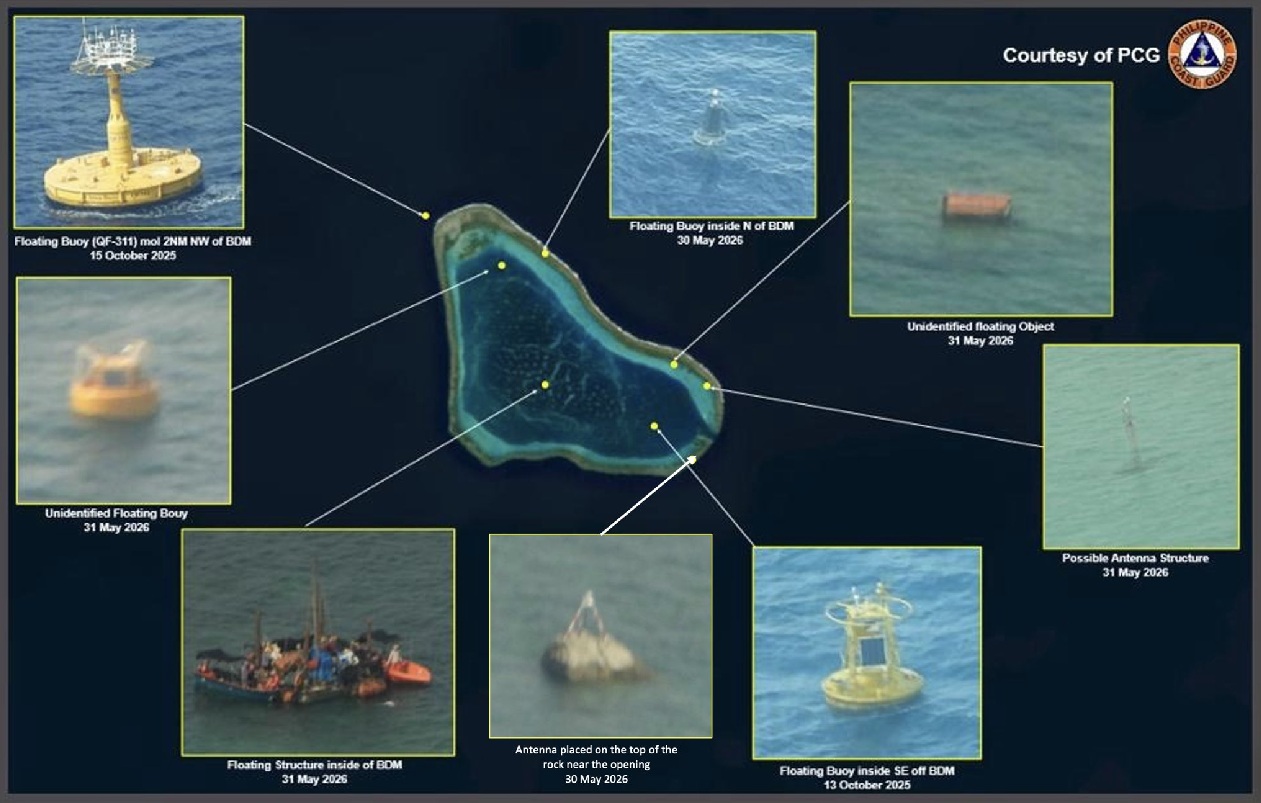
The Philippine authorities have unveiled images of structures at a contested reef. They suspect these were installed by China. Since May 30, six foreign objects have been identified at Scarborough Shoal’s lagoon, according to a Philippine coast guard spokesperson.
Scarborough Shoal, referred to as Bajo de Masinloc in the Philippines and Huangyan Island in China, is a critical point in the South China Sea dispute. Since a standoff in 2012, Beijing has maintained de facto control over the area without occupying it physically.
We flew planes over Bajo de Masinloc, or Scarborough Shoal, to see what structures are being built there—whether it’s a floating structure or a fixed structure, said Philippine military chief Romeo Brawner Jr. in Quezon City. We will also send ships.
The newly identified objects under Manila’s scrutiny include an antenna on a rock at the lagoon entrance, a second suspected antenna, a floating structure, an unidentified cylindrical object, and three buoys, in addition to two discovered in October. Another object, a mobile makeshift structure with six occupants, is also being monitored, according to Brawner.
Previously, China deployed barrier structures to block local fishermen from the lagoon, although Filipino personnel later removed them. The increasing number of structures, particularly those with personnel, could further intensify Manila’s territorial dispute with Beijing.
The Philippine Foreign Affairs Department stated it has taken “appropriate diplomatic action” with China concerning the “illegal presence” of these structures. This comes from the interagency task force for West Philippine Sea, the region within the Philippines’ exclusive economic zone in the South China Sea.
An exclusive economic zone typically extends about 230 miles from a country’s coastline, providing exclusive rights to marine resource exploitation.
The Chinese Foreign Ministry has not denied Philippines claims regarding the origin of the objects. Instead, they reaffirmed their claim over Scarborough Shoal. China has indisputable sovereignty over Huangyan Dao and its adjacent waters. It is fully within China’s sovereign rights to carry out activities including scientific research at Huangyan Dao,
said Chinese Foreign Ministry spokesperson Lin Jian. Lin urged the Philippines to cease all maritime provocations and false claims.
Last summer, tensions rose around Scarborough Shoal when a Chinese navy destroyer and coast guard vessel collided while blocking a Philippine mission to supply local fishermen. The collision caused heavy damage to the Philippine ship, which claimed Chinese casualties without official Chinese confirmation.
China later declared a national nature reserve covering a significant portion of the shoal, provoking protests from the Philippines and the United States. The recent discovery of these structures suggests China might solidify its control over the area.
Collin Koh, a senior fellow at the Institute of Defense and Strategic Studies, noted these tactics match China’s methods in the South China Sea, East China Sea, and Yellow Sea.
China claims the majority of the South China Sea, crucial for maritime trade exceeding $3 trillion annually. This has led to protests from neighboring countries such as Vietnam, Taiwan, Malaysia, Brunei, and Indonesia due to the pervasive presence of Chinese vessels in disputed areas.
In 2016, the Philippines brought the issue before the Permanent Court of Arbitration in The Hague. The court’s ruling largely dismissed China’s extensive claims, a verdict Beijing continues to ignore.