
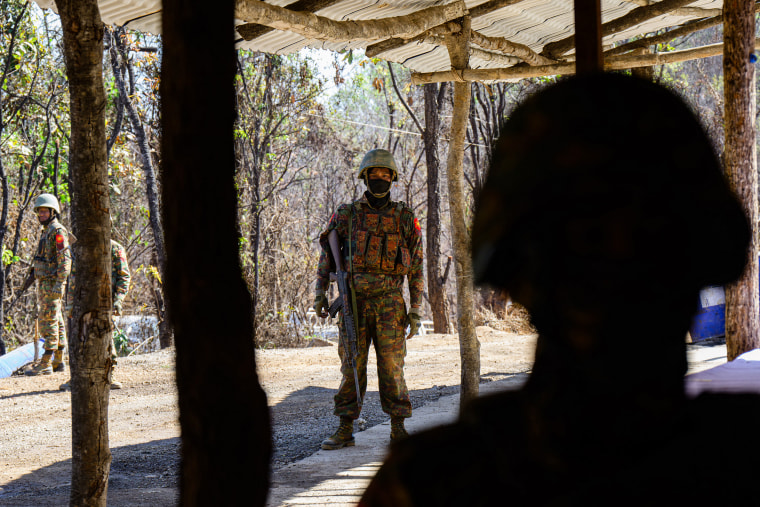
Since a new administration took office, Myanmar’s military has intensified its assaults on civilians, according to the Armed Conflict Location & Event Data Project (ACLED). The increase in violence follows the appointment of a new military chief in late March, coinciding with the outgoing leader’s transition to the presidency.
ACLED reported that the restructuring of Myanmar’s military command in March led to worsening repression and a rise in aerial bombing. This strategy includes deploying small groups of jet fighters for prolonged airstrikes on single targets. These actions represent a significant escalation in military tactics against civilians.
The Myanmar government has not responded to inquiries from Reuters regarding these developments. ACLED’s data collection relies on various sources, including media reports, U.N. findings, and insights from local and international organizations monitoring the conflict.
The turmoil in Myanmar began with the military coup in February 2021, which ousted Aung San Suu Kyi’s government. This coup led to a civil war causing about 100,000 fatalities and displacing millions. Before ascending to the presidency, Min Aung Hlaing, former junta leader, appointed Ye Win Oo, a trusted confidant and ex-spymaster, as the new military commander.
Under Ye Win Oo’s leadership, the military has launched fresh offensives in border areas rich in resources and vital trade routes. ACLED noted that civilian reprieve remains unlikely as the junta seeks to bolster its control amid the leadership transition from a military to a civilian presidency.
In the first half of 2026, ACLED recorded over a dozen mass killings, resulting in more than 450 civilian deaths, with approximately 40% occurring in the central Anyar region. A significant incident in Myit Chay township, near Bagan, involved around 700 junta troops, resulting in at least 40 deaths. Reuters could not independently verify these reports, which were part of ACLED’s event database.
These military strategies reflect a shift in the methods of civilian repression without decreasing its intensity, noted ACLED. The political shift in Myanmar has sparked diplomatic efforts, with Min Aung Hlaing visiting neighbors like India and China, and engaging with the Association of Southeast Asian Nations, which had previously excluded Myanmar’s generals from summits. An official visit to Thailand is scheduled for Min Aung Hlaing on August 6-7, aiming to enhance his legitimacy on the international stage.