
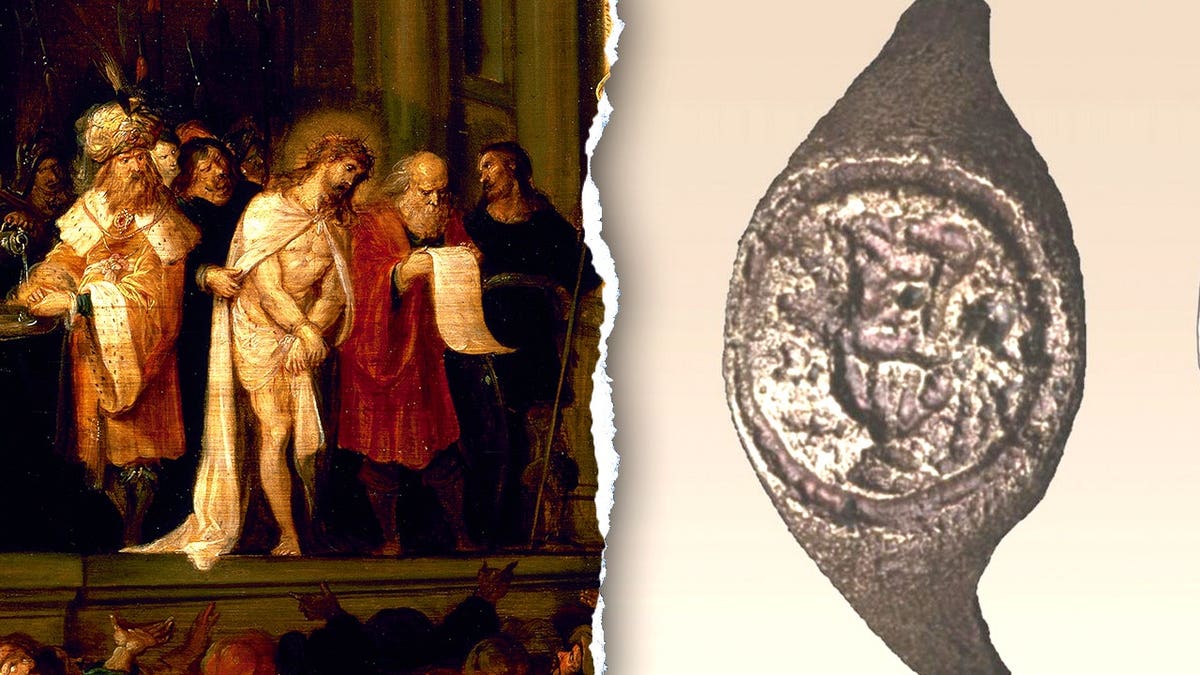
Recent research offers new insights into a ring bearing an inscription linked to Pontius Pilate. This artifact may hold clues about the Roman governor’s authority nearly 2,000 years after he sentenced Jesus Christ to death.
The ring, found at Herodium, a mountaintop fortress in the Judean desert, was discovered in the 1960s. Long known to archaeologists, its connection to Pilate has been re-evaluated recently. The University of California, Los Angeles (UCLA) released details about it in 2018, after the ring had remained in storage for over five decades.
A newly published study in Palestine Exploration Quarterly addresses this debate. Catherine Bonesho, a UCLA professor of ancient Judaism, analyzed the ring’s inscription and concludes that the wording is a transliteration of the Latin “PILATO” into Greek letters, meaning “for Pilate” or “to Pilate.” This interpretation challenges previous views that the inscription was a Greek form indicating “belonging to Pilate.”
The ring likely did not belong to Pilate himself, but may have been worn by a lower-status worker handling administrative tasks connected to him.
Understanding this artifact provides insight into the Roman administration of early Roman Judea, particularly regarding how authority was distributed in lower political structures. The ring’s poor quality and the Greek transliteration suggest it might have been used by secretaries or enslaved workers.
The ring’s discovery at Herodium during the 1960s archaeological work continues to interest scholars. Candida Moss, a historian of early Christianity, finds the research significant. She suggests the ring’s cheap construction indicates it wasn’t personally used by Pilate but by someone acting under his authority.
Moss mentioned that the ring, when used in business or legal decisions, symbolized the authority of Pilate and the Roman bureaucracy. This aspect aligns with biblical accounts, such as those in the Gospel of John, where Pilate is associated with the inscription “King of the Jews” on Jesus’ cross—even though historians doubt he wrote it himself.
The ring’s study enhances our understanding of Roman governance and biblical narratives, revealing the nuances of delegated authority in ancient times.