
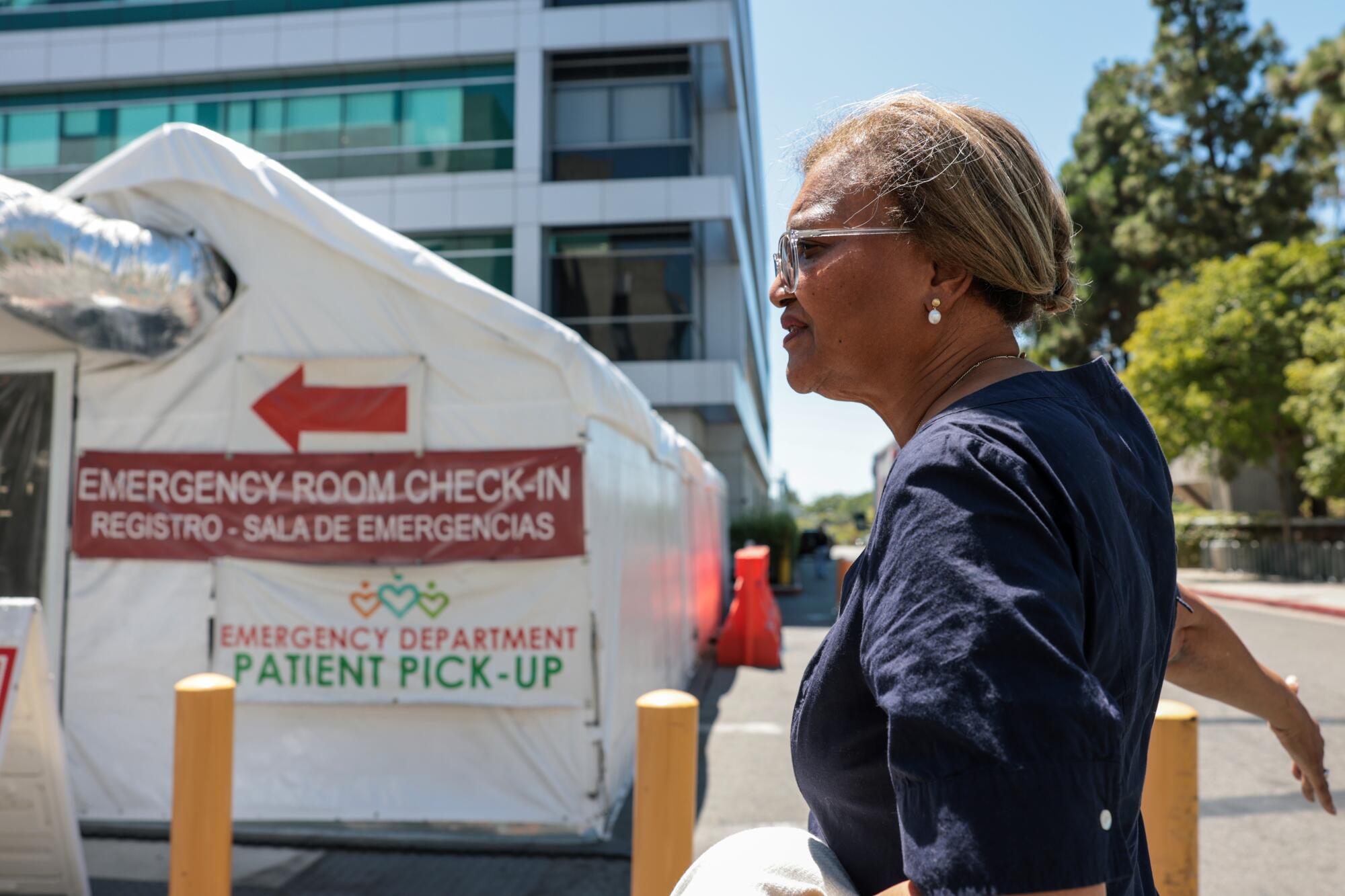
Martin Luther King Jr. Community Hospital in Willowbrook serves as the primary emergency medical facility for countless residents in South Los Angeles. Due to severe space constraints, many patients receive care in large, tent-like structures outdoors. This setup, reminiscent of the early COVID-19 pandemic days, highlights the hospital’s dire financial situation.
The hospital recently reported a net income of $14 million, but it ran at a loss in the previous three years. It anticipates a funding shortfall of $80 million to $100 million due to the impacts of the HR1 Act from 2025.
“One of the wealthiest cities in one of the wealthiest states in the country, and we’re caring for patients in four white tents on black concrete,” said Tony Weiss, director of media relations at the hospital.
Hospital leaders are urging the Los Angeles County Board of Supervisors to reevaluate the distribution of funds collected from Measure B. This property tax measure is intended to support trauma centers and emergency services. However, ongoing funds primarily go to county and private hospitals with trauma centers. MLK Hospital must rely on leftover funds, which have bailed it out four times between 2023 and 2025.
Despite being a nonprofit hospital, MLK has never received ongoing funds from Measure B, while Cedars-Sinai, a major private hospital with trauma capabilities, benefits significantly. Cedars-Sinai reported $1.1 billion in net income last fiscal year, yet opposes changes to the fund allocation formula.
“Changing the allocation formula risks undermining the system that Measure B was designed to protect and sustain,” emphasized Cedars-Sinai spokeswoman Sally Stewart.
The overcrowding at MLK Hospital’s emergency department exacerbates the situation. The facility has 29 beds intended for 25,000 visits a year, yet now accommodates over 120,000 annually. MLK’s leaders aim to renovate under-utilized spaces to expand capacity but lack funds to do so.
CEO Dr. Elaine Batchlor highlights the concerning disparity in Measure B fund distribution. She argues for reconsidering allocations to better assist hospitals serving financially needy communities.
“There are communities that are much more in need than Beverly Hills and West L.A.,” Batchlor advocated.
If MLK were to close, Director of Public Health Dr. Naman Shah warns of devastating consequences and the community’s lack of healthcare access.
The hospital serves one of the least financially secure populations in South Los Angeles. They had nearly 85,000 Medicaid/Medi-Cal visits in 2023, the highest in California. Pastor Robert Taylor, a community advocate, asserts that funds should better meet community needs.
Los Angeles County Supervisor Holly Mitchell plans to address this disparity by suggesting a measure to study fund allocation. She believes all hospitals play a vital role in emergency care, necessitating an independent review of fund distribution.
“We owe it to the public to ensure that Measure B funds continue to support and stabilize a strong, countywide trauma and emergency care system,” Mitchell stated.