
The moon is about to take center stage with a partial lunar eclipse, set to cover nearly the entire lunar surface. A remarkable 96% of the moon will be obscured Thursday night into Friday, offering a spectacular celestial event for billions. The Americas will enjoy prime viewing.
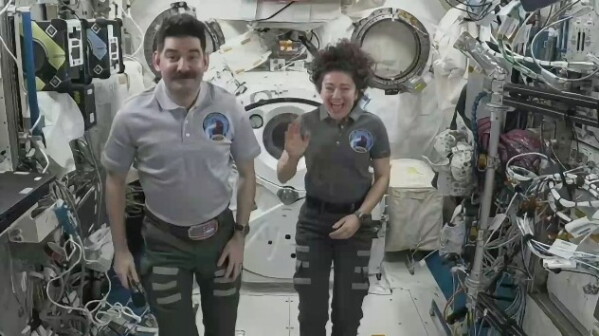
NASA’s recent lunar missions, including the record-breaking Artemis II flyby, are pushing toward more ambitious plans for lunar exploration. NASA astronaut Jack Hathaway, speaking from the International Space Station, highlighted the excitement of these ongoing efforts. ‘This is a great time to be part of the space program.’ he noted.
Celestial Alignments
This lunar event comes on the heels of a total solar eclipse experienced in regions such as Greenland, Iceland, and Spain. Eclipses usually occur in pairs when the sun, moon, and Earth align so precisely that one obscures the other. Despite the moon being 400 times smaller than the sun, its distance from Earth makes them appear the same size, providing these astronomical coincidences.
The upcoming eclipse will unfold at a slower pace than the recent solar spectacle, possibly attracting a wider audience due to its visibility across several continents, including North and South America, Europe, Africa, and the Middle East, weather permitting.
A View from Space
The lunar eclipse may also be visible to astronauts aboard the International Space Station and China’s orbiting outpost. According to space station commander Jessica Meir, observing such cosmic events from space offers a ‘unique perspective.’
During this eclipse, Earth will cast a reddish-orange shadow on the moon. As a partial eclipse, the alignment won’t be perfect, distinguishing it from a ‘blood moon.’ The entire phase will last over five and a half hours, with the partial eclipse phase extending for more than three hours. The peak will hit just after midnight EDT.
Global Participation
Audience numbers are impressive; nearly 1 billion people in North and South America will witness the entire eclipse. More than 3 billion globally, approximately 44% of the world’s population, will see at least part of it.
Viewers in Europe, Africa, and the Middle East will see the moon setting, shortening the event. Meanwhile, Hawaii and parts of the U.S. and Canada will catch the rising moon and the eclipse’s start.
This is the second lunar eclipse of the year and the fourth eclipse overall. A complete lunar blackout is not expected until New Year’s Eve 2028, featuring Asia and Australia. It will be 2029 before both North and South America experience another total lunar eclipse.
The Associated Press Health and Science Department acknowledges support from the Howard Hughes Medical Institute’s Department of Science Education and the Robert Wood Johnson Foundation. The AP independently handles all content.