
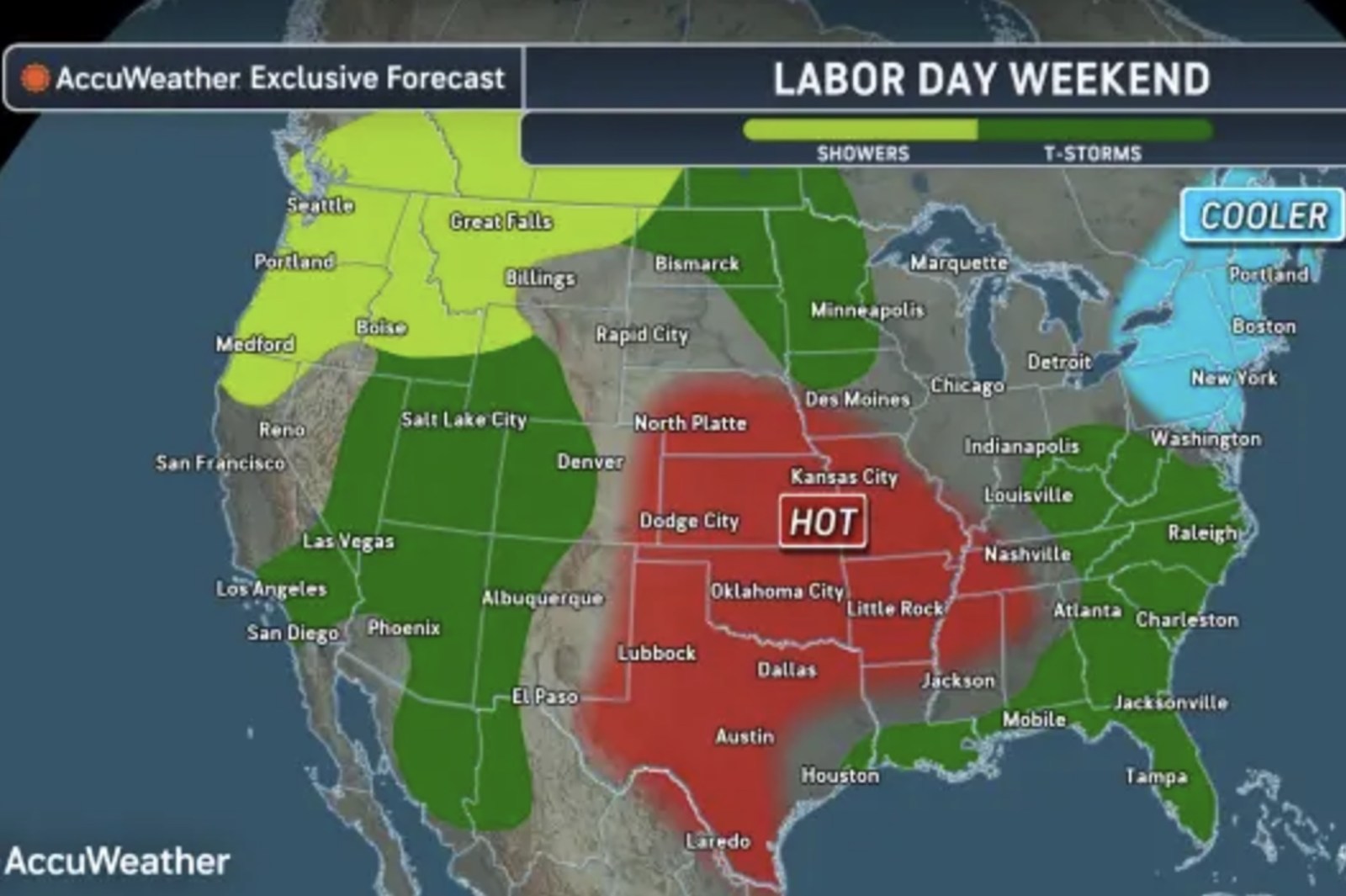
Labor Day weekend presents a challenging weather scenario across the United States. Extreme heat is predicted in parts of the central U.S., while storms could cause flash flooding from the West to the Southeast. The National Weather Service (NWS) has issued warnings for numerous areas, highlighting the significant risk of heat-related illnesses during extreme heat and humidity.
Central States Brace for Extreme Heat
AccuWeather reports that a massive heat dome will affect the central and southern Plains and the Mississippi Valley. Cities across Texas, Oklahoma, Missouri, Tennessee, and Nebraska should prepare for late-summer heat, with temperatures possibly exceeding 100 degrees Fahrenheit. High humidity will increase the apparent temperature, making it feel hotter by up to 15 degrees.
The NWS forecast indicates increased heat across the middle Mississippi Valley, the Ohio Valley, and the Tennessee Valley. Heat advisories are in effect due to dangerously high temperatures. The NWS Weather Prediction Center’s recent communication notes the record warmth as the result of a persistent high-pressure ridge.
“Record warmth will continue into early week with widespread Moderate to Extreme Heat Risk,” the NWS stated.
Storms Ring the Edge of the Heat Dome
While areas beneath the heat dome will remain relatively dry, the surrounding regions face showers and thunderstorms. These storms will affect much of the West, the northern Plains, the Midwest, and the Southeast. Expect torrential rain, flash floods, and damaging winds.
The NWS predicts showers and thunderstorms over the Southwest from Wednesday. Coverage and intensity will increase by Thursday, resulting in heavy rain. Similar weather patterns will impact the Great Basin, the central and southern Rockies, and areas from the lower Great Lakes to the northern mid-Atlantic.
What Is a Heat Dome?
A heat dome forms under a stationary high-pressure system, which traps heat and humidity. This causes the air beneath to sink and compress, raising temperatures. The expanding hot air creates a bulging dome, resulting in continuous hot weather and warmer nights. Vulnerable populations face increased health risks.
NOAA’s Michael Muccilli explains that “the system’s sinking air combined with abundant sunshine contributes to further warming.” Heat waves from these pressure areas can last one to two weeks.
Flash Flood Concerns in Texas
Texas faces flood risks after Tropical Storm Edouard, now a tropical depression, moved across the state. Expected to weaken further by Thursday, Edouard will still bring heavy rain to eastern Texas, leading to potential flash floods. Urban areas, roads, small streams, and low-lying spots remain particularly vulnerable.
AccuWeather also warns of potential flash floods due to storms at the heat dome’s edge, especially in the West, where thunderstorms will cause heavy rainfall.