
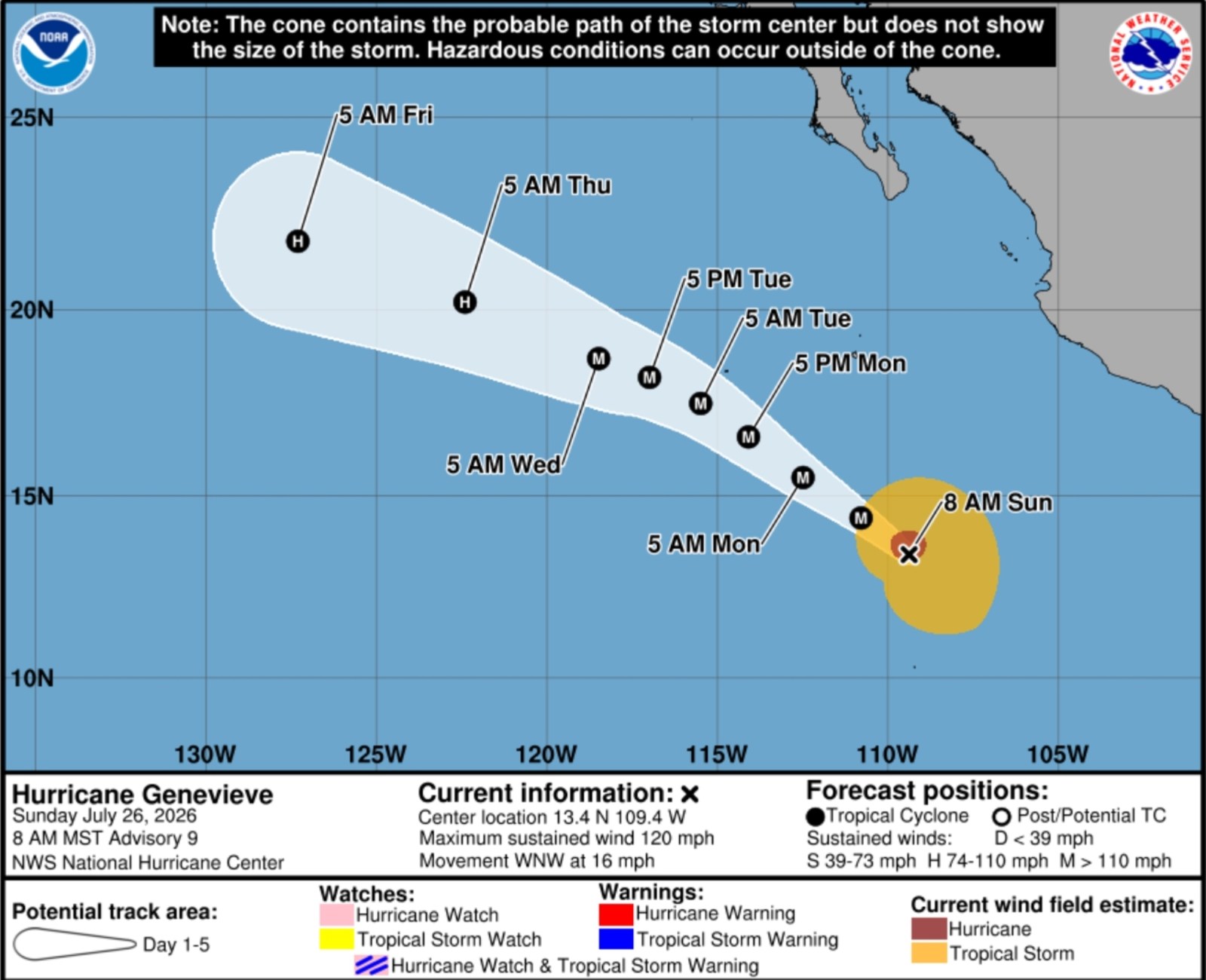
Hurricane Genevieve has become a significant force in the 2026 Eastern Pacific season as the first major hurricane, also marking the first in both the Eastern Pacific and Atlantic basins this year. Forecasters anticipate that the storm might strengthen further to reach Category 4 status by Monday.
Current Status and Location
The National Hurricane Center (NHC) reported that Genevieve, currently a Category 3 hurricane, possesses maximum sustained winds of 120 miles per hour, moving over the eastern Pacific Ocean well southwest of Mexico. Although it is not expected to make landfall, there is a possibility of the storm gaining more strength in the next few days.
Tracking Other Storms
Apart from Genevieve, the NHC is also monitoring Hurricane Fausto, which is potentially impacting Hawaii. Contact has been made with the NHC for further details.
Understanding Major Hurricanes
Major hurricanes are categorized as Category 3, 4, or 5 storms on the Saffir-Simpson Hurricane Wind Scale (SSHWS), having sustained winds of at least 111 mph. These storms can inflict devastating wind damage and notable coastal impacts if they approach populated areas. Genevieve achieved this classification on Sunday after intensifying rapidly.
During a Category 3 hurricane, significant damage can occur if the storm nears land. Well-built framed homes may experience severe damage, numerous trees may fall or become uprooted, and roads could become blocked. Essential services, including electricity and water, might be unavailable for several days to weeks after the storm passes, according to the NHC.
Genevieve’s Position and Strength
As of Sunday morning, Genevieve was about 515 miles southwest of Manzanillo, Mexico, moving west-northwest at approximately 16 mph. The hurricane’s minimum central pressure had decreased to 963 millibars, another indicator of its strengthening.
Tracking and Future Impacts
Weather footage from windy.com shows Genevieve moving off the coast of Mexico with robust winds. Satellite imagery captures the storm’s defined eye. Although heavy rain is forecasted to remain offshore, coastal areas might face some effects. The NHC advisory noted that swells generated by Genevieve are affecting parts of the southwestern Mexican coast and are likely to reach southern parts of the Baja California Peninsula soon, posing risks of dangerous surf and rip currents.
Forecasts suggest Genevieve will stay over open water, eventually encountering cooler sea temperatures and unfavorable environmental conditions, leading to weakening. Despite this, experts predict the storm will maintain its major hurricane status at least through Wednesday morning.
Genevieve’s emergence marks an important point in the 2026 hurricane season, with no active monitoring of other storms in the Atlantic.