
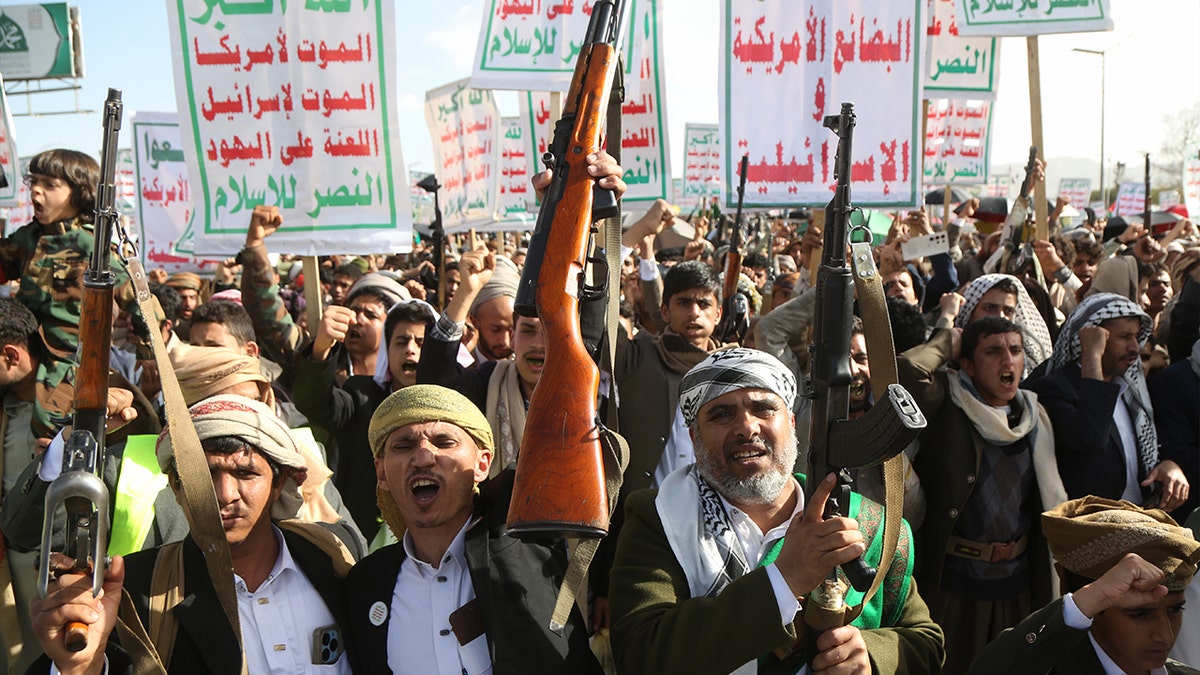
The Houthis, an Iran-backed group, are moving swiftly toward a pivotal maritime chokepoint, drawing attention to their expansive financial strategies. This network has bolstered the group from a local insurgency into a regional power that now poses a threat to global trade routes.
Recently, the Houthis seized critical areas on Yemen’s Red Sea coast, including the port city of Mocha, advancing toward the Bab el-Mandeb Strait. This waterway is crucial for global maritime trade and energy shipment.
For the U.S., halting the Houthis’ progress is as much a financial issue as a military one. The United States is striving to cut off funding that sustains Iran and its affiliates, but the Houthis have cultivated a network that evades sanctions while overseeing ports, trade routes, and millions of Yemenis. This presents a formidable challenge.
Saudi Arabia has urged U.S. military action as the Houthis threaten the Bab Al-Mandeb Strait. They plan missile-drone attacks if neighboring Gulf nations join the U.S.-Israel conflict against Iran.
The Houthis maintain a financial network extending far beyond Yemen. Adam Rousselle, from Between the Lines Research, terms them ‘well-capitalized.’
In past investigations, Rousselle illustrated how the Houthis finance their operations through port control, tariffs, Iranian oil, informal networks, and international collaborators across Russia, Turkey, and Southeast Asia.
Port control significantly boosts Houthi revenue, essential for a nation dependent on imports. According to Rousselle, the Houthis levy heavy fees at controlled ports and tariffs on goods entering from competing Yemeni ports.
Their territorial gains further reinforce their financial strength. Nadwa Al-Dawsari from the Middle East Institute emphasized the importance of territory to the Houthis’ resilience during congressional testimony.
‘Territory is a key source of leverage,’ Al-Dawsari said. ‘It allows the Houthis to recruit, generate income, manufacture arms, and rebuild capabilities.’
While Iranian direct funding is substantial, experts like Rousselle argue the Houthis operate within a larger Iranian commercial system, disproving assumptions of simple financial transfers.
Miad Maleki from the Foundation for Defense of Democracies highlights the Houthis’ adaptation to sanctions, mainly generating funds inside Yemen through customs and taxes.
While Treasury estimates over $2 billion annual revenue from oil sales by the Houthis, they also receive free monthly shipments from Iran via companies in Dubai. Treasury has noted taxes on petroleum imports as another revenue source.
Scott Bessent, the Treasury Secretary, faces the challenge of targeting where Houthi funds interact with formal financial systems.
‘Sanctions cannot impact local extraction,’ Maleki noted, ‘but they can target the connections between domestic finances and international systems.’
Sa’id al-Jamal, identified by Treasury, leads a network funneling proceeds from Iranian commodities sales to the Houthis. April 2025 reports estimate the network facilitated tens of millions in weapons and commodities from Russia, revealing eight digital asset wallets linked to the Houthis.
Russia plays a significant role, possibly more actively involved than Iran, according to Rousselle.
Relations with China are complex; while some private Chinese entities appear involved, direct government involvement remains unproven.
Reports show a Chinese firm provided satellite imagery aiding Houthi attacks on U.S. vessels. Furthermore, components of Houthi drones predominantly originate from China.
These financial networks challenge Treasury efforts to isolate Tehran economically. Decentralized illicit finance networks defy standard sanctions methods. Washington must identify points where Houthi money crosses into the formal system to enact immediate change.
Oman is noted as another strategic pressure point being a key transit route for the Houthis.
Disrupting Houthi finances risks worsening the humanitarian crisis in Yemen. Ports remain critical for civilian food and fuel supplies
Experts suggest keeping essential goods flowing while eliminating financial benefit for Houthi authorities.
This issue extends beyond Yemen. Sanctioned groups globally exploit financial systems outside regulatory control, demanding broader scrutiny.
Efrat Lachter, a seasoned Fox News Digital reporter, contributes insights from her extensive career in conflict and global affairs. Her experiences include covering crises and global conflicts, earning awards and recognition in her field.