
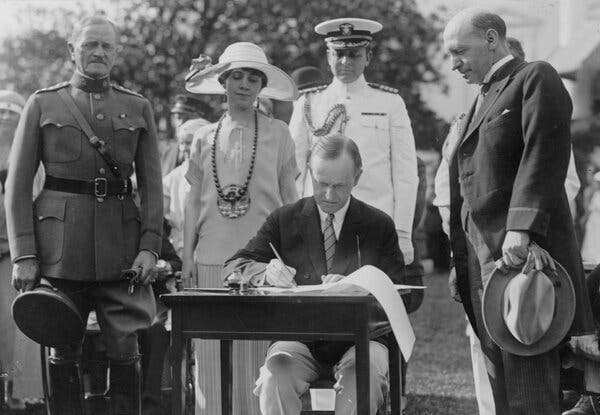
In 1924, the United States Congress enacted legislation that significantly curtailed immigration, sending a clear message: the country would no longer be an open refuge. Economic and social anxieties spurred the imposition of quotas that restricted immigration from countries like Italy, Poland, and Russia. It also virtually eliminated immigration from Asia, setting a cap of 150,000 immigrants annually, moving away from the inclusive vision presented in Emma Lazarus’s famous poem.
Representative Albert Johnson, a Republican from Washington, expressed the sentiment of that era, stating, “It has become necessary that the United States cease to function as an asylum.”
Today, many historians draw parallels between those historical dynamics and President Trump’s policies. Unlike the 1920s, Trump has largely acted independently, without congressional approval, to reinforce border controls.
Utilizing broad administrative actions and new powers confirmed by the Supreme Court, Trump has scaled back immigration significantly. His administration has prohibited asylum at the southern border and denied deportation protections for individuals from countries affected by conflicts and disasters. Refugee acceptance has been restricted, with exceptions mainly for a group of white South Africans. Policies have been put in place to halt long-term immigration from regions in the Middle East and Africa while attempting to limit green cards for those perceived as potential dependents on government assistance.
Additionally, Trump has overseen the deportation of hundreds of thousands, facilitating voluntary departures under the threat of exile to perilous third countries.