
Two Greek firefighting helicopters collided midair while battling a wind-driven wildfire west of Athens. Footage captured the moment, showing one aircraft crashing to the ground. The helicopters, both Bell models, had a two-person crew. Tragically, two crew members, one from Greece and one from Denmark, lost their lives. Two others, one Greek and one British national, survived. Further details regarding the survivors were not immediately available. The deceased crew members’ helicopter affiliation remains uncertain.
The collision highlights the peril facing firefighters in Europe’s volatile wildfire emergency. Strong winds intensified flames, spreading them deeper into the region near Athens and triggering additional evacuations. The fire began on Friday near Agios Vasileios, advancing toward Porto Germeno and forested areas west of Athens. Firefighters evacuated 254 people by sea on Friday and another 12 on Saturday as roads from coastal communities became inaccessible.
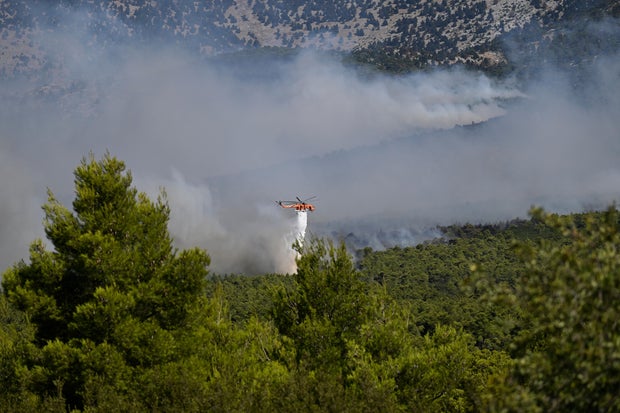
A firefighting helicopter drops water near Porto Germeno, northwest of Athens, Greece, Aug. 2, 2026. Michael Varaklas / AP
Nearly 500 firefighters and 23 aircraft were deployed to combat the flames, but gale-force winds hindered efforts. Aircraft had difficulty reaching the sea to collect water, allowing fire to spread rapidly through western Attica. This region, encompassing Athens, faced threats to communities and industrial areas as violent wind gusts blocked water collection from the sea. The advancing fire recalled the 2018 Mati wildfire, Europe’s deadliest since 2000, which claimed 104 lives.
Authorities issued evacuation orders for Kandili, Agia Skepi, and Toutouli, as smoke billowed above the mountains. Porto Germeno, a Gulf of Corinth seaside community, was of particular concern. Greek Prime Minister Kyriakos Mitsotakis received updates on firefighting operations. In other parts of Greece, flames endangered homes on Kefalonia, prompting evacuations from inland areas. Aircraft performed water drops over the Ionian island, while another blaze near Nea Tenedos in Halkidiki kept firefighters engaged.
Earlier reports noted the deaths of two firefighters combating a blaze on Crete, with a third casualty occurring in the Peloponnese. Local farmer Minas Tzortzanis lamented the devastation, saying, “A pristine forest, a paradise, was surrendered to the hands of the fire. There are no words to explain what has happened. Destruction. Total destruction.”
Beyond Greece, fires in France and Spain displaced approximately 250,000 people, affecting homes, vacation sites, and communities during the peak of the European summer. Emergency services faced simultaneous disasters across the continent. Europe began 2026 after experiencing the worst fire year on record, losing over 3,860 square miles to flames in 2025. According to the European Environment Agency, wildfires have caused nearly 800 deaths across Europe over 40 years.
Europe is recognized as the world’s fastest-warming continent, warming over twice the global average since the 1980s, as stated by the European Union’s Copernicus Climate Change Service. Human-induced climate change increased the likelihood of extreme fire-weather conditions responsible for this year’s French fires, with scientists at World Weather Attribution finding them at least twice as likely. This rapid analysis was conducted during ongoing fires.