
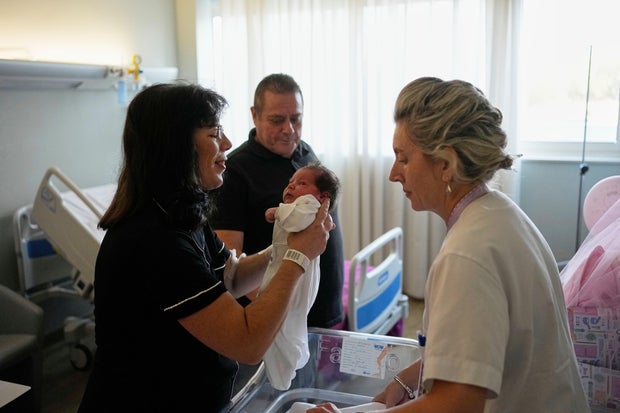
In a story blending loss and hope, a Greek couple welcomed a new child into their family under unique circumstances. Cristina Rapti-Tzelepi and her husband faced the Greek government’s age restrictions for in vitro fertilization, which set the limit at 54 years of age. Despite these boundaries, Rapti-Tzelepi, aged 54, successfully gave birth to a daughter using one of her embryos frozen 22 years prior. This came after the devastating loss of their 21-year-old son in a road accident last October.
The couple’s determination led Rapti-Tzelepi to act swiftly within a narrow 2.5-month window to ensure the procedure’s approval. “It was stressful,” she admitted, “but with inner strength and the support of our doctors, we overcame every obstacle.” Their daughter was born in Athens, weighing 7 pounds, 11 ounces, amidst joy and emotion from the new parents.
Dr. Kostas Pantos, who played a pivotal role, has advocated for a review of Greece’s age policy on IVF, highlighting the country’s declining birth rates. He emphasized how a law permitting IVF beyond the age of 54 might better reflect contemporary society’s needs. The couple’s decision took significant inspiration from similar past successes, such as an Ohio couple who used an embryo aged over 30 years, setting a world record in the process.
The newborn, named Georgia in honor of their late son Giorgos, filled the couple’s home with renewed laughter and hope. Georgia’s birth symbolizes not only a personal triumph but also a broader societal narrative involving rising trends in embryo donation and adoption.
As noted by CBS News, embryo donation in the U.S. is becoming increasingly popular, with transfers nearly multiplying four-fold from 2004 to 2019. The existence of over a million frozen embryos in the U.S. highlights the growing interest and ethical considerations related to IVF processes.
The couple remains open to expanding their family further, possibly by seeking fertility assistance abroad. Their journey highlights the evolving landscape of reproduction technologies and the deeply personal stories they shape.