
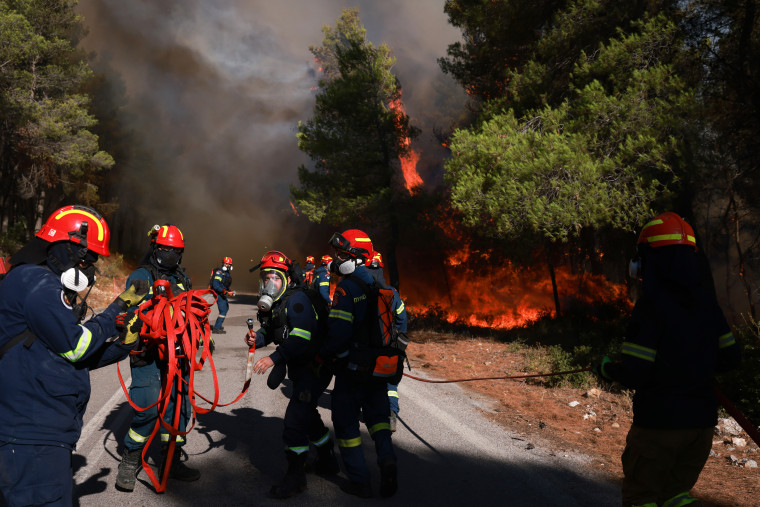
On Sunday, Greek firefighters continued their efforts to control a massive wildfire that has destroyed over 100 homes northwest of Athens. Meanwhile, a new blaze prompted evacuations on the popular tourist island of Kefalonia.
This summer, Europe has faced widespread wildfires following record-breaking heatwaves and minimal rainfall. Scientists attribute these conditions to climate change.
In France and Spain, wildfires showed signs of subsiding over the weekend. However, Greece experienced several new outbreaks after a period of relative calm.
Wildfires in Greece
Gale-force winds had exacerbated the fire around Porto Germeno, located about 40 miles northwest of Athens. Although the winds have decreased, the flames spread south to Veniza and a military firing range, triggering unexploited ordnance.
Nearly 500 Greek firefighters, equipped with vehicles, heavy machinery, and firefighting aircraft, have been dispatched. France and Romania have also provided reinforcements.
In the village of Agios Konstantinos, residents took action to stop the fire’s spread. Tasos Tzempelikos, a 61-year-old resident, shared their efforts of pouring water on the fire to assist firefighters.
According to the Greek daily Protothema, a significant effort focused on preventing the blaze from Veniza from reaching the nearby coastal town of Megara. Reports indicate that more than 38 square miles of land have been damaged so far.
In the Ionian island of Kefalonia, evacuations took place in several settlements in the Pastra area due to a fire outbreak.
Fire Situation in France and Spain
In France, wildfires in the Gironde and Var regions have shown signs of easing. Authorities have only reported minor flare-ups in the southwestern Gironde area. Additionally, the blaze in the southeastern Var area did not spread overnight.
Central Spain saw wildfires under control after affecting tens of thousands of hectares over the past week. However, firefighters were dealing with flare-ups in some locations.
In western Spain’s Caceres province, a forest blaze on Saturday led to the evacuation of around 800 people. These residents returned home on Sunday but were advised to stay inside as the fire remained active.
Drought and Water Challenges
Several European countries are facing drought, with declining water levels in major rivers like the Rhine and Danube. These conditions have resulted in the lowest water levels ever recorded in Hungary, Serbia, and Romania.
“Hungary faces a critical five days,” Prime Minister Péter Magyar stated, revealing that the country’s only nuclear power plant had to shut down for the first time in over 40 years due to the drying Danube. A new heatwave was looming.
Water levels have dropped across Hungary, interrupting shipping and tourism activities and leading to water use restrictions in over 100 cities and villages.
Serbia’s Danube levels fell to their lowest marks since 1985, reducing the output of the nation’s largest hydropower plant to only 20% of its capacity, according to the energy minister.