
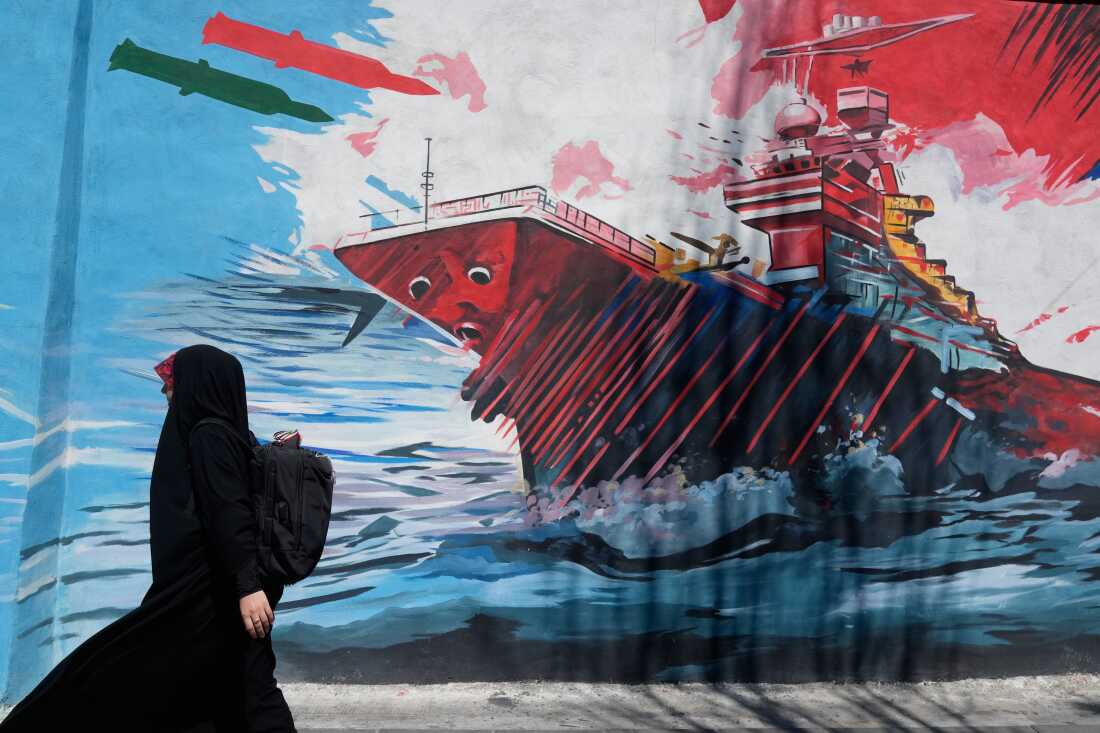
A woman walks past a mural in downtown Tehran, Iran, depicting a U.S. aircraft carrier under missile attack. This scene illustrates the increasing tensions between the U.S. and Iran. Recently, the U.S. military announced another round of strikes against Iran, following a statement by President Trump. He warned Tehran of repercussions for stalled negotiations.
U.S. Central Command stated on social media that the targets in Iran were a response to continued Iranian aggression. These strikes occurred after Bahrain, Kuwait, and Jordan, which host U.S. troops, faced Iranian attacks. This series of back-and-forth strikes tests a two-month ceasefire.
The recent confrontations began with a U.S. strike on Iran after an Army helicopter crash near the Strait of Hormuz, blamed on Iran by President Trump. As oil prices surge due to the conflict, there is mounting pressure on the global economy. Trump asserts that Iran must sign a peace deal swiftly.
Iranian Envoy Amir Saeid Iravani warned the U.S. against using force, stating that “Iran has never negotiated under threats.”
Despite the intense conflict, both countries show an interest in a resolution. Israeli Prime Minister Netanyahu’s goals complicate these efforts, as he aims for the downfall of Iran’s government and its nuclear program.
The impact of this conflict is notable in the economic sphere. Since the conflict’s initiation on February 28, energy costs have risen, affecting the global market. The price of crude oil recently exceeded $93 a barrel.
In recent developments, President Trump claimed over 100 million barrels of oil have bypassed Iran’s control in the Strait of Hormuz. However, confirmation of these figures remains absent. U.S. military involvement in these shipments is not fully disclosed.
The conflict also involved the U.S. disabling the engine room of the M/T Settebello, an oil vessel, which was reportedly breaching a naval blockade with Iranian oil. India’s foreign ministry reported three Indian sailors missing after the attack.
Earlier, the U.S. military targeted Iranian facilities, affecting water supplies in Sirik. Tehran retaliated with attacks on Bahrain, Kuwait, and Jordan. The situation escalated with both nations trading accusations of aggression.
Efforts for peace continue alongside military actions. A Qatari delegation arrived in Tehran for discussions. These diplomatic moves highlight the complexity of reaching a resolution.
As Trump seeks a resolution against the backdrop of upcoming elections, significant hurdles remain. The U.S. demands the removal of Iran’s uranium stockpile and is unwilling to unfreeze Iranian assets without a comprehensive agreement. Trump recently accused Iran of stalling negotiations, intensifying the urgency for a deal.