
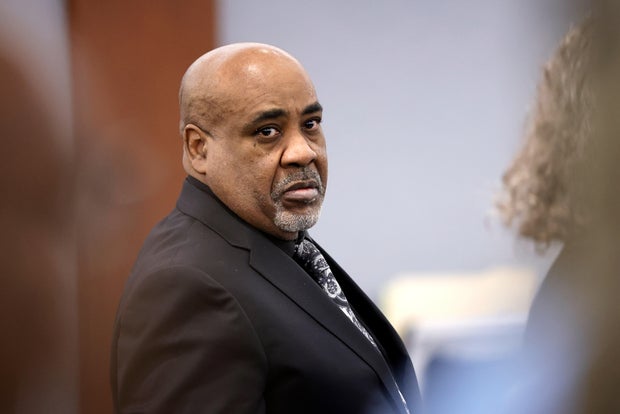
Michael Sanft, defending Duane “Keffe D” Davis, who was convicted of first-degree murder for the 1996 shooting of Tupac Shakur, questioned the jury’s impartiality. He accused them of holding “preconceived notions” against his client. On Tuesday, Sanft expressed surprise over the jury’s swift verdict, suggesting they failed to consider all the evidence.
“With the amount of evidence that should have been considered by the jury, I don’t believe that they went through it,” Sanft commented. He highlighted the mere three hours taken by the jury to deliver the guilty verdict as indicative of bias, stating, “My feeling is that they had preconceived notions, and those notions were what led to the conviction for Duane Davis.” Nevada law does not mandate a minimum deliberation time for jury members.
During the trial, Sanft noted his priority was dealing with pre-trial motions about allowable evidence. He acknowledged there were “bigger issues” concerning jury impartiality back then.
Prosecutors alleged Davis obtained the weapon used to kill Shakur and organized the Las Vegas drive-by shooting on Sept. 6, 1996, in retaliation for the earlier assault on Davis’ nephew, Orlando “Baby Lane” Anderson. Chief Deputy District Attorney Binu Palal remarked that Davis was “hunting” for Shakur and Marion “Suge” Knight, Shakur’s associate wounded in the incident.
“It is a slam-dunk, absolutely no defense to murder case,” stated Chief Deputy District Attorney Marc DiGiacomo in his closing remarks.
Although not charged as the shooter, Davis’s role in aiding the crime sufficed for a conviction under Nevada law. Audio from a 2008 interview revealed Davis’s admission that Anderson fired shots after Davis handed a gun to the backseat. Anderson, who passed away in unrelated violence, never faced charges for Shakur’s murder.
Davis, the lone survivor among those allegedly involved, had previously avoided prosecution through cooperation with authorities. However, his 2019 book “Compton Street Legend” and public statements nullified this protection.
Sanft criticized Judge Carli Kierny’s decision to present Davis’s other illicit behaviors, like gang affiliation and drug trafficking, as “inappropriate.” He challenged Kierny’s guidance to the jury, which downplayed the need for corroborating evidence if they considered Davis’s self-incriminating declarations.
“Going into the trial, we knew already that we were behind on the scoreboard,” Sanft reflected. He likened it to a one-sided football game, “52 to 0 walking in at the opening kickoff.” The judge’s instructions compelled him to question his own client’s reliability.
“It was the only defense strategy when convicted solely on one’s words without factual backing,” Sanft stated, disputing evidence of Davis’s presence in Las Vegas on the shooting day. “There is no actual evidence that supported the conviction,” he said, viewing the verdict as based more on sentiment than solid proof.
Davis’s sentencing is scheduled for Oct. 13, with a potential life imprisonment sentence. Sanft plans to appeal the conviction, foreseeing a lengthy process.