
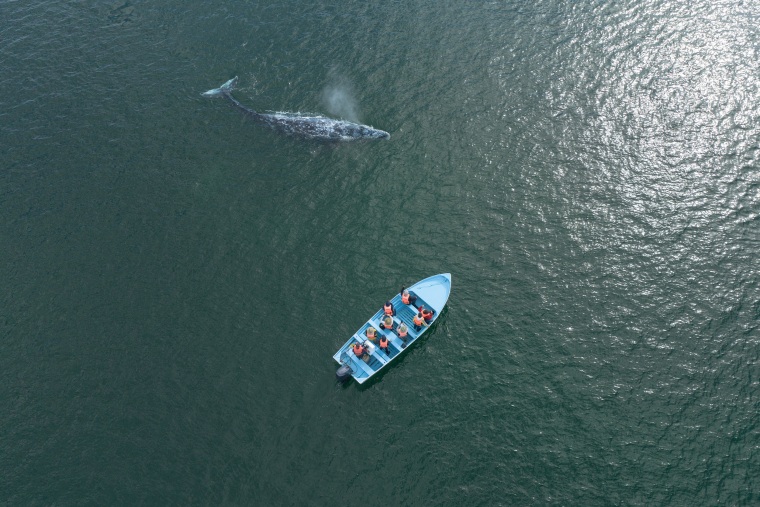
Since March, Washington state has seen an alarming number of gray whales washing ashore. Research biologist John Calambokidis reports that 21 whales have died along the coast. Calambokidis, who founded the Cascadia Research Collective, has been studying gray whales for many years. Previously celebrated as a conservation success, gray whales have faced a significant decline over the past seven years.
Many stranded whales are noticeably thin and weak, with some exhibiting unusual behavior before dying. Scientists link the whales’ struggles to global warming, particularly the decline of sea ice. This climatic shift affects the whales’ food supply, triggering a chain of unfavorable events. “We know it’s a food supply issue,” Calambokidis states. The Arctic, undergoing significant changes, has seen a reduction in the whales’ favored prey.
Josh Stewart, an assistant professor at Oregon State University’s Marine Mammal Institute, notes the gray whales are highly sensitive to environmental conditions. “I don’t think we’ll see an Arctic that can support 25,000 gray whales again,” he remarks. Since 2019, gray whale deaths have been termed an “unusual mortality event” by the National Oceanic and Atmospheric Administration. Although there was a brief population increase in 2023, the decline has continued.
Gray whales migrate north in spring and summer to the Arctic for feeding, and head south in fall to Mexico for reproduction. While in the Arctic, they feed on amphipods for four to six months. This is crucial as they fast for the next six to eight months. Nutrient changes due to earlier sea ice melt have affected food availability. Earlier melting allows sunlight to nurture phytoplankton, which competes for nutrients needed by the whales’ prey. Thus, a bad summer impacts the following spring, with whales expending more energy than they acquire.
Calambokidis highlights cases of whales stranded in unexpected locations, like one found in the Wilapa River, Washington. Malnutrition and disorientation lead them to precarious situations. NOAA’s estimates suggest a steep decline in the gray whale population, from 27,430 a decade ago to 12,950 last summer.
Some whale groups, like the Sounders in Puget Sound and the Pacific Feeding Group off the coasts of California and the Pacific Northwest, remain less affected by these changes. Elliott Hazen from NOAA suggests these groups exemplify alternative foraging strategies, offering hope for adaptation.
In past centuries, commercial whaling severely reduced gray whale numbers. The introduction of the Marine Mammal Protection Act allowed their recovery, removing them from the endangered list in 1994. Stewart does not foresee extinction but acknowledges the declining abundance and the challenges in recovery.