
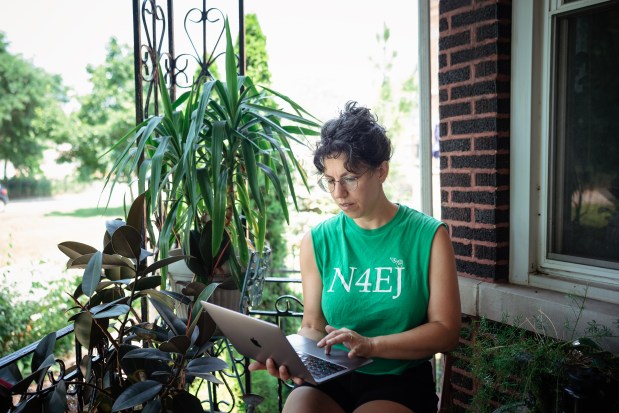
Sonia Monet Saxon frequently wakes at 4 a.m. to the smell of burning asphalt near her McKinley Park home. Her residence’s proximity to an asphalt plant often makes stepping outside difficult. Before the recent surge in PM2.5 from wildfires, pollution was already a constant issue in many areas. This is why Saxon installed an air quality sensor at a McKinley Park house; it’s the fifteenth such installation she has completed. Her aim is to track emissions from the asphalt plant.
“I love this neighborhood, but the air often smells like burning asphalt,” Saxon explained. On certain days, the odor is almost unbearable. Air quality in Chicago is gauged through various means, ranging from inexpensive sensors like Saxon’s to more sophisticated regulatory monitors. Saxon, a community science organizer with Neighbors for Environmental Justice, has installed sensors costing $289 each from PurpleAir in pollution-prone neighborhoods. Funding for these sensors often comes from grants, including from the University of Illinois Chicago (UIC). The sensors measure pollutants like PM2.5, which originate from factories, vehicles, and wildfires.
The PM2.5 readings from Saxon’s new sensor revealed fluctuating levels, indicating potential risks for sensitive individuals. Wildfire smoke recently pushed PM2.5 levels to hazardous heights. According to AirNow, PM2.5 levels skyrocketed, raising health hazards for everyone exposed.
Chicago and UIC launched the Open Air Chicago project, a large air monitoring initiative. It uses solar-powered sensors across the city, placing more in industrial neighborhoods. These sensors inform residents about local air quality, aiding in understanding pollution data.
Anthony Moser, of Neighbors for Environmental Justice, notes that while air quality tracking is crucial, addressing pollution sources is vital. Increasing air monitoring awareness among residents can enhance engagement with these issues. Despite regulatory monitors’ precision and cost, many prefer the lower-cost sensors for community use.
With six federal air monitoring sites, Chicago offers stringent regulatory monitoring analyzed by chemists. However, the cost and complexity lead many to use less expensive sensors. These sensors, though convenient, have limitations in accuracy and environmental vulnerability.
Satellite data may offer future solutions for comprehensive air monitoring. As satellites can observe large areas, they might fill gaps left by limited ground monitoring. Despite challenges, integrating satellite data with existing systems could better track pollution citywide.
As McKinley Park residents navigate air quality issues, future strategies aim for improvement. The city must address ongoing concerns with seriousness, altering enforcement and planning methods for better air quality outcomes.