
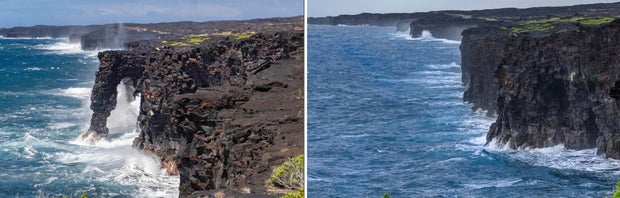
The Holei Sea Arch, a scenic natural feature on Hawaii’s Big Island, has collapsed. Situated within the Hawaii Volcanoes National Park, the arch stood approximately 90 feet tall before falling between September 23 and September 27. The National Park Service provided this information, noting that the collapse may have occurred while the park was closed due to Tropical Storm Nolo.
Hawaii Volcanoes National Park made a social media post about the incident, stating that the exact timing of the collapse remains unknown. Tropical Storm Nolo, which passed over the area, had maximum winds of 155 mph, heavily impacting the state with rain and strong winds during the period.
Following the storm, Hawaii Governor Josh Green reported that an emergency declaration received approval from the Trump administration. This declaration is intended to facilitate federal support and resources for the state’s recovery efforts post-storm.
Photos, provided by USGS, depict the Holei Sea Arch before and after its collapse. These images were shared via AP.
Prior to this event, in August, the region experienced Tropical Storm Lala. This storm resulted in significant damage, including the loss of around 100 homes, landslides, and widespread power outages.
The National Park Service had anticipated the collapse of the arch, recognizing it as part of the ongoing evolution of the park’s coastline. They described the formation as beautiful, yet temporary, highlighting its limited lifespan.
Reactions to the park’s announcement on social media showed many users viewing the collapse as a natural process. However, the park service warned visitors to avoid the unstable site, citing severe risks of falling.
Despite warnings, photos have shown people approaching the closed area of the former sea arch, endangering both themselves and first responders. The Holei Sea Arch was a popular tourist attraction, formed about 550 years ago. Its name derives from a local plant within the milkweed family.