
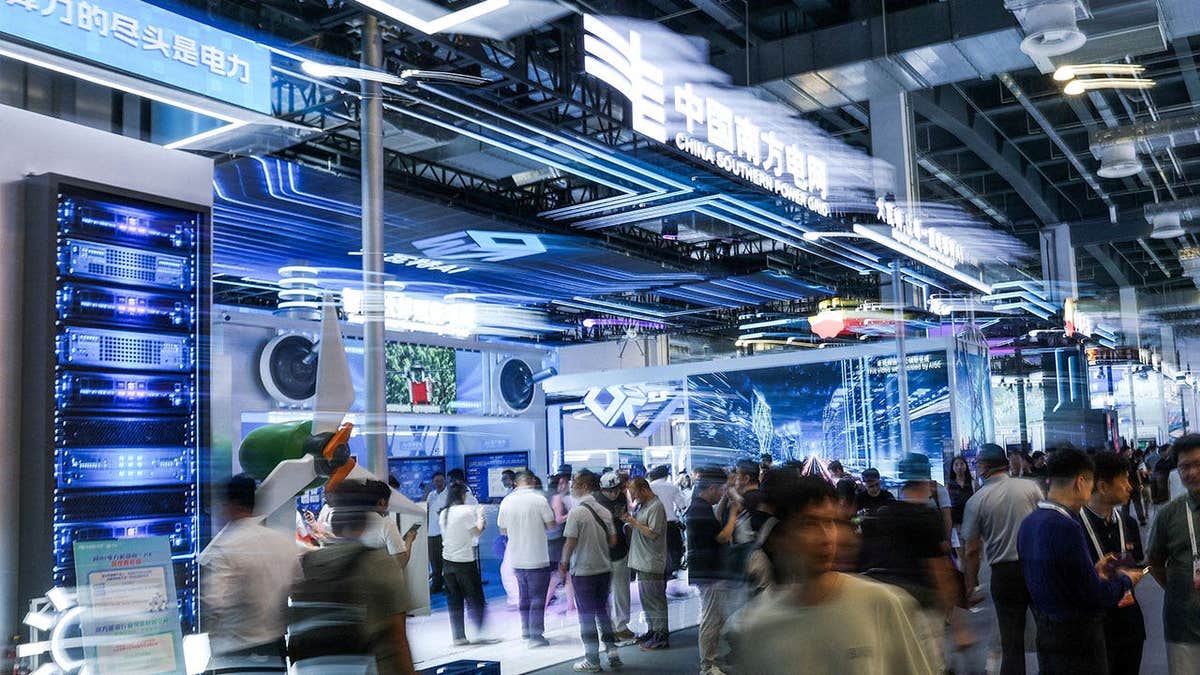
China is making fast progress in building data centers and energy infrastructure to support artificial intelligence (AI). This rapid development raises concerns that China might close the gap with the United States in AI infrastructure. The U.S. holds a significant lead in the number of data centers. According to the Stanford Institute for Human-Centered Artificial Intelligence’s 2026 AI Index, the U.S. had 5,427 data centers in 2025 compared to China’s 449. However, this count doesn’t consider the size or capacity of these facilities.
China is swiftly catching up. China expert Gordon Chang warns that while the U.S. is ahead, China’s quick progress could pose a challenge if the U.S. doesn’t continue expanding at the same pace. He notes that growing opposition to data center development in the U.S. could slow American expansion. Former President Donald Trump issued a warning, suggesting that anti-data center sentiments could benefit China economically. He mentioned that the construction of data centers could provide jobs and tax revenue to communities.
U.S. Vice President JD Vance added that the real challenge is America’s capacity to produce enough power to support data centers and infrastructure. He emphasized that the U.S. needs to ease regulations to support power plant construction alongside data centers. There is a growing gap in electricity generation, with China producing roughly three times as much power as the U.S.
The Chinese Embassy in Washington, represented by spokesperson Liu Chang, stated that AI should not be viewed as a geopolitical contest. Instead, China aims for collaboration with the U.S., highlighting their 2025 Global AI Governance Action Plan. This plan encourages developing clean power, networks, computing capacity, and data centers, advocating for mutual benefits in AI development.
Beijing is reorganizing its infrastructure, focusing on western regions for data center construction where there’s available land and resources for renewable energy. Five of China’s eight national computing hubs are situated in western regions. This is part of the ‘East Data, West Computing’ initiative, aimed at utilizing geographic advantages for data center development.
During a fact-finding trip, members of the bipartisan U.S.-China Economic and Security Review Commission noticed China’s focus on the AI frontier, involving assets like robotics and biotechnology. Commission Vice Chairman Mike Kuiken noted China’s ability to rapidly build infrastructure due to relaxed legal constraints. However, he identified a key weakness for China: the lack of access to advanced chips.
The demand for data centers is evident in the U.S., particularly in Texas, with companies seeking infrastructure for intensive computing needs driven by AI advancements. Despite China’s rapid progress, the U.S. maintains advantages in AI development. Stanford’s AI Index for 2026 indicates that the U.S. produced 59 significant AI models in 2025, compared to China’s 35, and that investments in AI were substantially higher in the U.S.
Some claim that China might exploit American resistance to data centers. Protests in the U.S. potentially influenced by China-linked networks have emerged. Yet, local concerns over costs and development are more significant drivers of opposition.
The competition between the U.S. and China isn’t solely about developing AI models. It’s also about building the necessary support infrastructure and resources to run these models at scale rapidly.