
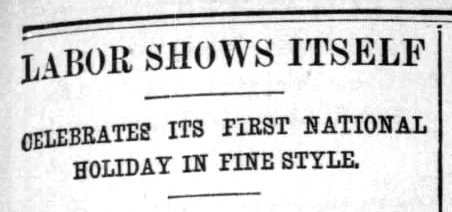
1894: First Labor Day Parade
The Chicago area saw a significant event on Sept. 3, 1894, as thousands of tradesmen and union members joined a parade to commemorate the country’s first Labor Day. Despite inclement weather, more than 6,500 members from various unions, including carpenters, painters, and plumbers, led a procession to Ogden’s Grove.
1904: Charles Dvorak’s Olympic Journey
In 1904, Charles Dvorak of the Chicago Athletic Association competed in the Summer Olympics in St. Louis. Prior to this, Dvorak had traveled to France in 1900, where he misunderstood the scheduling of his pole vault event, leading to his absence. Despite the setback, he received a silver medal in a subsequent event for American athletes. At the 1904 Olympics, Dvorak set an Olympic record with a vault of 11 feet, 6 inches, winning gold. He made strides by using a lighter bamboo pole instead of the usual ash or hickory.
1906: Capture of Paul Stensland
Paul Stensland, a fugitive bank president from Chicago, was located in Tangier, Morocco, in September 1906. The Chicago Tribune uncovered his whereabouts and convinced him to surrender. Stensland had absconded with over $1 million and later faced trial, resulting in his imprisonment in Joliet. The Tribune’s managing editor, James Keeley, was compensated with a $5,000 reward for capturing Stensland, which he donated back to the victimized Milwaukee Avenue State Bank.
1970: Billy Williams’ Game Streak Ends
Chicago Cubs Hall of Famer Billy Williams saw an end to his consecutive games streak on Sept. 3, 1970. Having played 1,117 straight games, the left fielder did not play as the Cubs prevailed over the Philadelphia Phillies 7-2.
1975: Chicago Teachers Union Strike
The Chicago Teachers Union (CTU) voted on Sept. 3, 1975, to strike, delaying the school year’s start. The nearly 9-to-1 approval for the strike centered on contract disagreements, smaller class sizes, and better compensation. By Sept. 17, a new contract settled the issues, granting a 7.1% pay raise, smaller classes, and improved benefits, totaling a $79.6 million agreement.
1984: CTA Extension to O’Hare Airport
The Chicago Transit Authority extended its rapid transit line to O’Hare International Airport on Sept. 3, 1984. At a cost of 90 cents for a one-way ticket, the extension made the “L” more cost-effective compared to taxis or shuttles, as noted by the Tribune.