
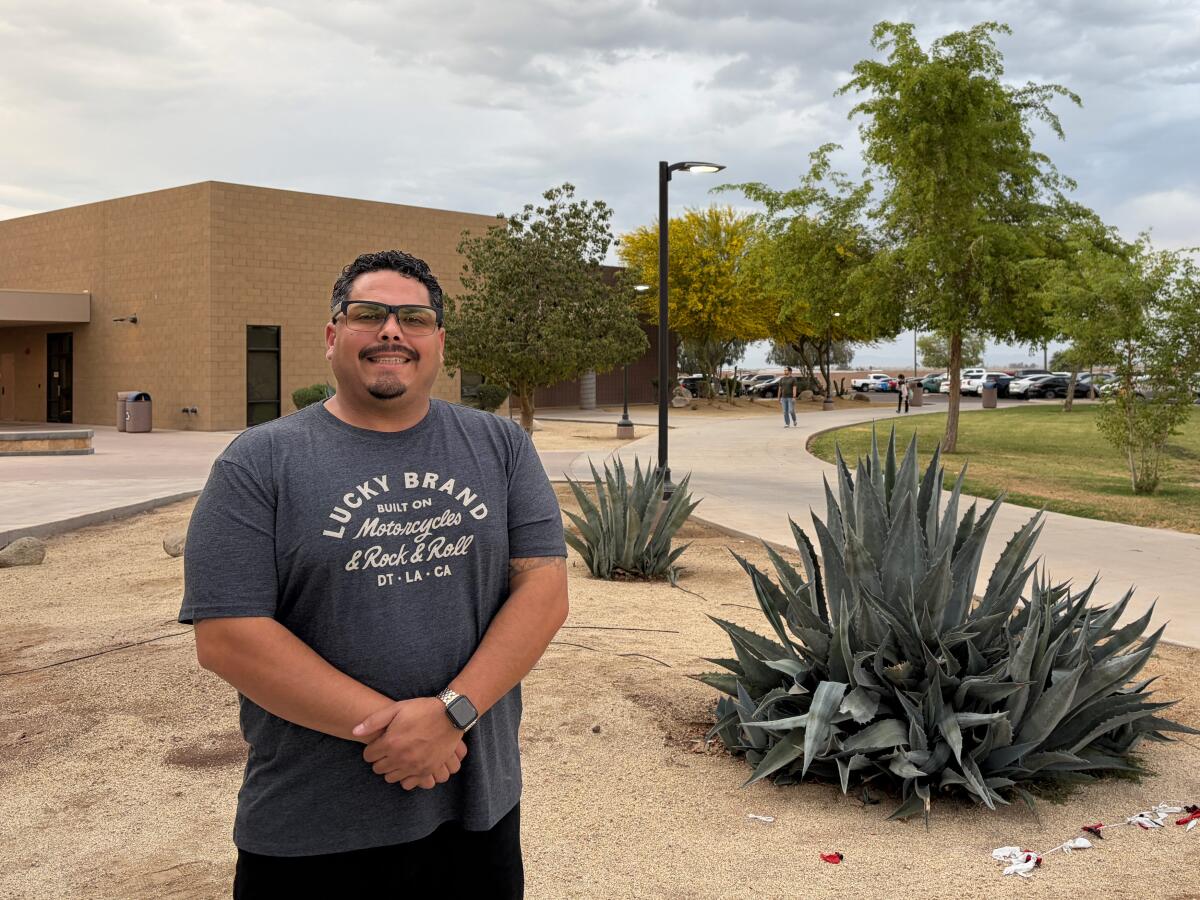
Imperial Valley College introduced a program to prepare students for jobs in the burgeoning lithium sector. Corban Dillon joined the first class with the hope of a career in this promising industry. However, after earning his certificate in spring 2024, jobs in the lithium field remained scarce. Despite enrolling in two more similar programs, Dillon and many others found that employment opportunities in lithium extraction were limited. This mineral is crucial for batteries that power clean energy transitions.
“Many of us balance jobs and family while seeking certification,” said Dillon, 41. “Without immediate job prospects, it’s tough to stay committed.” This highlights a challenge for community colleges: local residents want jobs in new industries, but they require skills and training that locals often lack. Institutions like Imperial Valley College attempt to launch programs in time to prepare students before outsiders fill the anticipated jobs. The college is now scaling back its lithium training programs due to job market uncertainties, becoming a case study in the risks of preparing students for new fields.
Betony Jones of UC Berkeley’s Labor Center described it as an “incredibly common” issue. Various fields, influenced by political and economic conditions, face similar uncertainties, including solar energy and advanced manufacturing, typically requiring further education.
Jones explained, “Employers need workers when projects start, but workers can’t wait to be trained upon hire.” Dillon, as a student in the Lithium Industry Force Training program, is one example. This agricultural region of Imperial County has both high poverty and unemployment rates, exceeding 16.9% in March, over three times that of nearby counties.
Priscilla Lopez, the county’s director of workforce and economic development, expressed a prevailing mindset, “If we want opportunities, we need to leave the valley.” Yet, a potential lithium boom raises hopes for local jobs, as firms began examining the area’s lithium reserves roughly a decade ago.
Berkshire Hathaway Energy Renewables announced potential operations by 2026, but it is currently only completing a demonstration plant, as noted by Christina Fleming, vice president of mineral development. Similarly, Controlled Thermal Resources is still seeking funds, with jobs expected in about two years.
The lithium beneath the Salton Sea could power 375 million electric car batteries. With increased educational demands, Imperial Valley College and San Diego State quickly acted. San Diego State received $80 million for a new STEM campus near a prospective lithium site, planning new degree programs in engineering and chemistry to align with local industry needs.
Imperial Valley College received U.S. Department of Energy funding for its training programs. These programs offer plant operator, chemical lab technician, and instrumentation technician certificates within two semesters. Courses include chemistry, math, and water treatment operation. Promoted as a fast track into the lithium industry, these programs attract locals who yearn for stable employment.
George Prieto, 48, who enrolled in the plant operator program, is entering higher education for the first time. Previously in retail, he also works as a DJ on weekends. He value the proximity to work opportunities, “Usually, jobs draw people from around the world; this program offers a chance locally.”
Industry setbacks have been attributed to various factors, including a lawsuit by environmental groups, shifting political landscapes, and market forces. Environmental concerns about a project by Controlled Thermal Resources remain pending, while some companies have diverted efforts toward other projects like data centers.
Federal attention has shifted to lithium projects in places like Arkansas and Nevada. A California Energy Commission member warned of Lithium Valley’s uncertain future, with San Diego State’s President echoing concerns of graduates facing an empty job market due to slow progress.
Yet, the college continues. Since 2023, 173 students joined certification programs, 42 completed them, and 57 remain enrolled. However, only 16 have jobs directly related to their training, said Lennor Johnson of the Imperial Community College District.
The college plans to pause two certificate offerings, with intentions to revive them by 2027-28, aligned with industry developments. Prieto remains hopeful his skills will apply to other industries. Dillon, optimistic about the lithium industry’s potential, took a full-time job with a mining company offering good pay and benefits. The opportunity, though, is not nearby.