
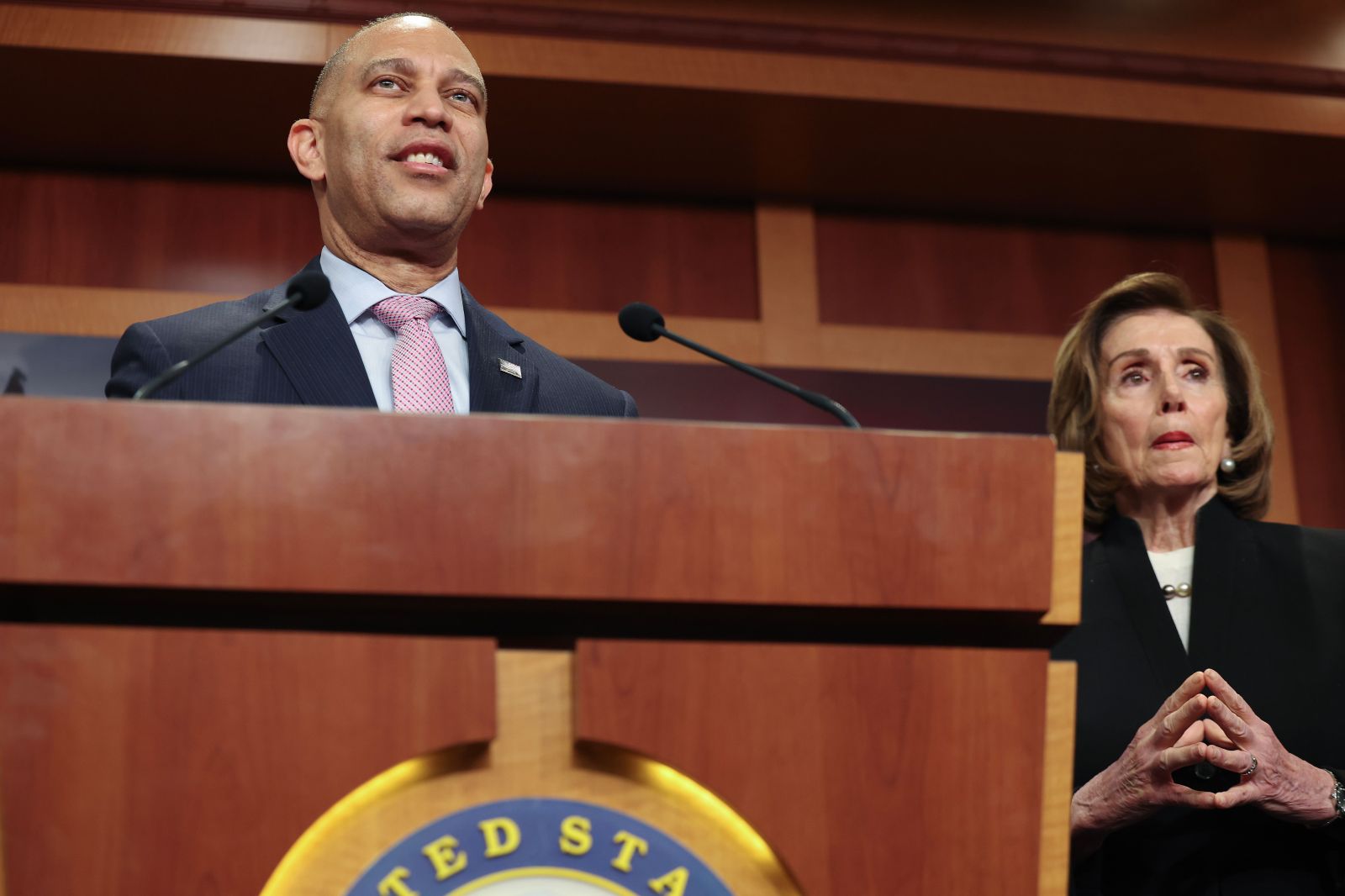
Hakeem Jeffries has occupied the House Democratic Caucus leadership office once held by Nancy Pelosi for nearly three years. Comparing his leadership style to Pelosi’s is inevitable, given her two-decade tenure. A recent procedural vote provides further cause for Democrats to make this comparison.
Maine Representative Jared Golden and Washington Representative Marie Gluesenkamp Perez, both Democrats, crossed party lines, aiding Speaker Mike Johnson after a conservative rebellion disrupted plans. Five Republicans intended to vote against the rule due to an earlier spending dispute, risking its failure without Democratic support. The rule passed by a narrow 210-208 margin.
Pelosi, who chose Jeffries as her successor in 2023, highlighted a divergence in leadership styles. She stated, “I, as speaker, never even considered that anybody would do that. We never had that problem, so I’m disappointed that they did that.”
Jeffries’ Leadership Compared to Pelosi
Pelosi maintained strict control over the House Democratic Caucus, rarely encountering procedural defection. Her command helped secure her reputation as one of Congress’s most effective leaders. However, Golden and Gluesenkamp Perez’s votes have intensified critiques of Jeffries. Critics argue that Jeffries lacks the same authority.
Emma Vigeland, a progressive commentator, perceived the incident as a failure on Jeffries’ part, stating, “Pelosi was no leftist, but she could whip her caucus… Jeffries is bad at the basics of his job.”
Jeffries follows a leadership line spanning three decades: Dick Gephardt, Pelosi, and now himself. Pelosi publicly praised him, noting in TIME 100 that he was “already doing a terrific job.” Despite this, criticism persists, citing a perceived lack of discipline akin to Pelosi’s.
Two years into his tenure, Jeffries faces criticism regarding his approach, particularly after Senate Democrats aligned with Republicans to end a government shutdown without healthcare subsidies. Pelosi urged Jeffries to “use your power” and take stronger actions against former President Donald Trump, amid frustrations over his cautious leadership.
Recent months have posed challenges for Jeffries. Criticism arose after naming Florida Representative Jared Moskowitz as ranking member of a committee critical of Israel, given growing dissatisfaction with Israel’s actions in Gaza. Additionally, Jeffries faced backlash after a meeting with Jared Kushner, discussing common grounds like housing and immigration.
Veteran strategist James Carville criticized Jeffries, advocating for limited interaction with Republicans unless necessary, describing them unfavorably.
Jeffries’ relationship with AIPAC has made him a target for the party’s left wing. New York City Councilman Chi Osse considered a primary challenge against him. Some Democratic candidates remain ambiguous about backing him for speaker if Democrats retake the House.
The Perception of a Weakened Leadership
Brooklyn-native Jeffries is facing unfavorable polling data. A July 2023 CNN poll showed 32% of respondents viewed him unfavorably, with only 16% favorably. This 16-point gap was the widest since tracking began in December 2022, when 19% held unfavorable views. By April, unfavorable ratings rose to 27% and further to 36% by spring.
A YouGov tracker indicated Jeffries ranked 22nd in popularity among national Democrats, trailing behind popular figures.
For some analysts, Jeffries’ leadership test awaits when Democrats regain majority status. The vote by Golden and Gluesenkamp Perez could provide the far left justification for future dissent, according to Jim Kessler of Third Way.
Tensions within the Democratic Caucus predate Jeffries, with dissatisfaction toward a rigid leadership structure lingering. While Pelosi managed the frustrations adeptly, old tensions are resurfacing with her absence.
Democratic strategist Basil Smikle contends that allowing vulnerable members to diverge aids their electoral success, highlighting that both Pelosi and Jeffries understand the importance of winning.
Democratic leaders, however, expressed disappointment in Golden and Gluesenkamp Perez’s votes, deeming them a “significant breach of trust.” They are considering referring the matter to the Committee on Caucus Rules for resolution.
Golden and Gluesenkamp Perez’s Vote Reasons
Golden and Gluesenkamp Perez supported a rule wanted by Johnson to push GOP-backed measures, like denouncing “socialism” and aiding Maine lobstermen—Golden’s chief concern. He argued that procedural sportsmanship isn’t crucial to his constituents.
Gluesenkamp Perez explained via social media the need for real working experiences informing policy, emphasizing the connection between environmentalism and working waterfronts.
Both representatives voted without informing leadership beforehand.
House Democratic Leaders Respond
Jeffries, Minority Whip Katherine Clark, and Caucus Chair Pete Aguilar released a statement condemning Golden and Gluesenkamp Perez’s decision as “blindside” to the caucus, warranting “serious response.”
Discussion of repercussions against the defectors remains ongoing, with Clark admitting no prior notice. Some caucus members support a stronger stance, while others propose punitive measures for such actions.