
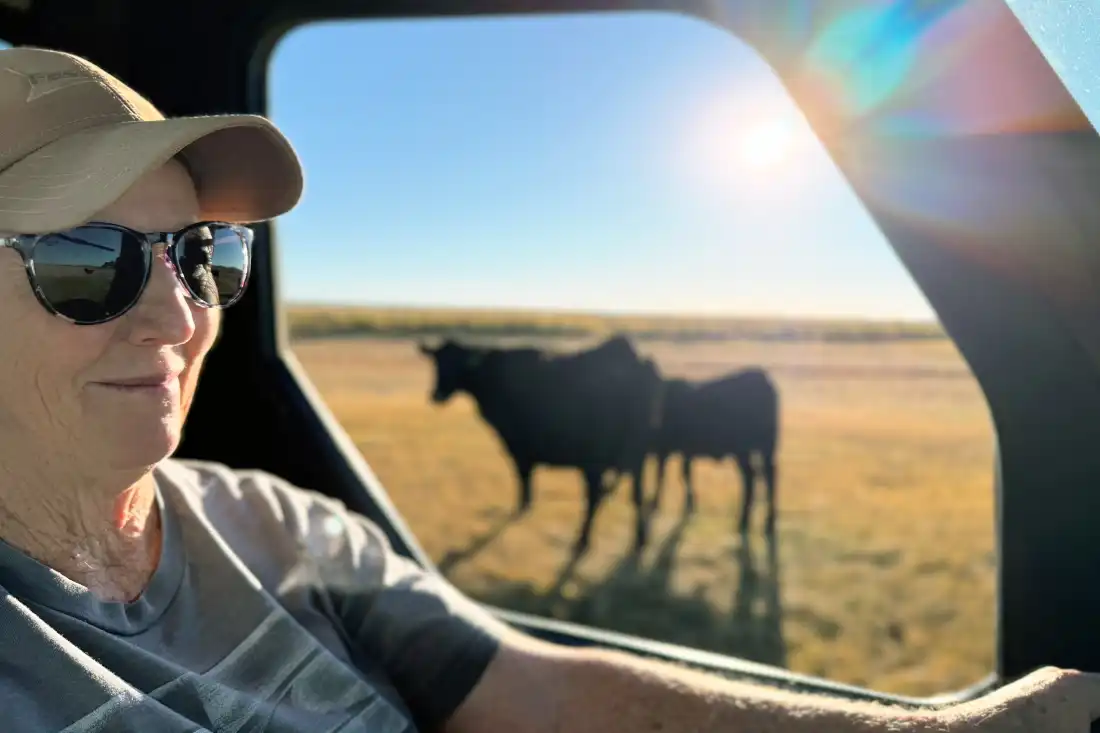
Katie Baltzor maneuvers her side-by-side vehicle, a sturdy machine akin to an oversized golf cart adapted for ranch work, among the black angus cattle she raises near her home in Hines, Oregon. The landscape is dotted with late-blooming rabbitbrush and steep eroded-basalt buttes. In these vast fields, horses snack on standing hay while Baltzor observes her cattle with a contented air.
The region is facing rising diesel prices, which are impacting the agricultural sector heavily. Despite measures taken by President Trump, ranchers in the western states continue to struggle as drought persists. In Harney County, cattle far outnumber humans, presenting challenges in feeding these many mouths.
Baltzor notes how fuel and parts costs have soared, highlighting the imbalance between increasing expenses and calf prices, which haven’t kept pace with inflation. This creates difficulties for ranchers trying to sustain their livelihoods.
Together with her husband Keith, Baltzor recently drove a herd of 150 cattle along Highway 205, handling the precarious situation as cars attempted to penetrate their group. It’s crucial, she advises, for motorists to keep moving steadily when facing a herd, avoiding actions that might alarm the animals.
They’re bringing the cattle closer to their home pasture for health checks, including pregnancy tests for mother cows and administering vaccines. Wildfires have devastated grazing grounds, forcing earlier returns than planned. The fires have scorched many acres, preventing access for years.
Without grass, hay becomes even more essential. However, drought conditions have reduced the yields from Baltzor’s hay meadows significantly. Diesel costs further complicate the situation, elevating the expenses of hay harvests.
With limited hay supplies, they’re employing rakebunching, avoiding repeated tractor passes to mitigate diesel costs. Though practical in the short term, this approach leaves minimal hay reserves for the subsequent year if precipitation remains low.
Purchasing hay requires long hauls or deliveries, adding to diesel expenses again. These financial strains are compounded by the ongoing challenge of retaining heifers to ensure future calf production. Ranchers must balance current transactions against long-term herd growth.
Baltzor and her partner have switched to gas-powered pickups to cut diesel expenditures. The financial stability of their ranch has been managed through hard-won independence, minimizing debt. However, many face leaner circumstances in southeast Oregon, particularly as winter approaches.