
Current Condition of the 6th Street Bridge
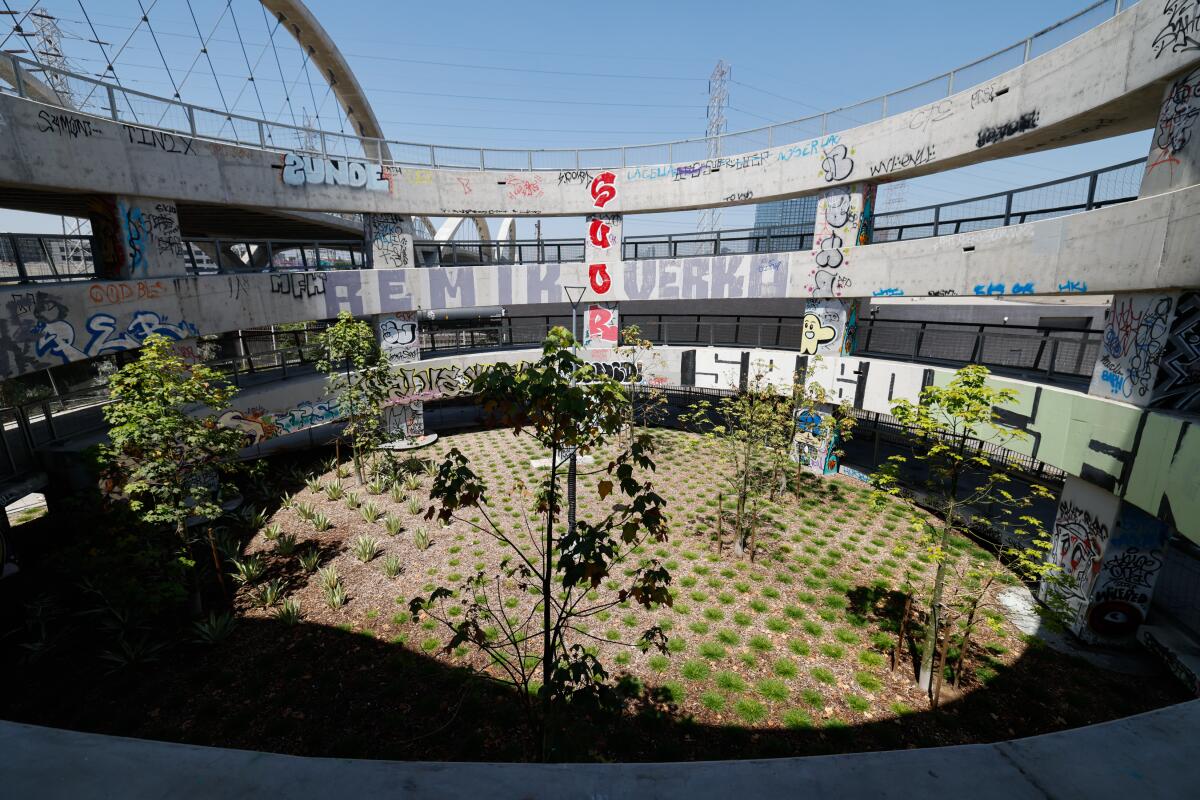
The 6th Street Bridge in Los Angeles, which cost $588 million to construct, opened four years ago as a significant public work. It was designed by Michael Maltzan Architecture and HNTB. Unfortunately, the bridge is now heavily marked with graffiti, primarily on its spiraling approaches, resembling open-air galleries. Copper wiring that once lit its arches like a rhythmic light ribbon has been stripped, leaving the bridge dark at night. Trash accumulates along walkways, contributing to the bridge’s decline.
The Promise of Sixth Street PARC
Beneath the bridge lies the anticipated Sixth Street PARC—Park, Arts, River, and Connectivity—slated to open this year. This $62 million project aims to revitalize former maintenance areas and neglected industrial spaces for recreation and culture. It seeks to unite Boyle Heights, a working-class Latino neighborhood, with the Arts District. However, the deteriorating bridge casts doubts on the park’s future.
Michael Maltzan emphasized the park’s essential role in the bridge’s overall concept—to change infrastructure from dividing communities to uniting them. The park will cover 12 acres, stretching from Mateo Street in the Arts District to the edge of Highway 101 in Boyle Heights. It includes features such as fields, plazas, playgrounds, and sports areas for Boyle Heights. The Arts District portion will have seating, fitness areas, a coffee shop, performance venues, and direct tunnel access to the L.A. River.
Challenges Faced
Despite ongoing construction and planting, graffiti already mars project signs, bridge columns, and shipping containers. Littler gathers along landscaping, raising concerns about the park following the bridge’s unfortunate trajectory.
Community Division and Business Improvement Districts
Part of the park is within the Arts District Business Improvement District, which funds neighborhood security and beautification. Executive director Miguel Vargas supports the park but acknowledges funding limitations outside their boundaries.
Unlike the Arts District, Boyle Heights lacks a dedicated business improvement district, dependent only on city-provided maintenance and security. A coalition of local property owners proposed forming the Boyle Heights Industrial Flats Business Improvement District to provide security patrols and street cleaning. However, this proposal raises concerns about potential private influences and exclusion.
Boyle Heights resident Derek Mejia expressed skepticism about the BID’s security efficacy, emphasizing existing heavy policing.
Industrial Growth and Gentrification Concerns
Boyle Heights has seen an influx of creative businesses from the Arts District amid fears of gentrification. Crime has been an issue, but recent interest from Hollywood, boosted by streaming wars, has attracted TV and film studios to the area.
The advent of studios such as East End Studios Mission Campus and Ace Mission Studios alongside facilities like wardrobe shops and production storage has transformed the local landscape. These entities support the BID proposal with hopes of improving neighborhood safety alongside park development.
Concerns About Displacement
Some residents fear success for the park could increase displacement risks in Boyle Heights, paralleling changes seen in the Arts District.
Verita Topete from Centro CSO worried affluent arrivants might escalate rental costs, threatening the community’s stability.
Community Engagement and Future Prospects
Efforts by Hargreaves Jones included public meetings, workshops, surveys and site tours to incorporate local concerns.
Neighborhood council secretary Margarita Amador stressed the need for ongoing dialogue and cooperation between city officials, private organizations and residents to address challenges and potential shifts.
Anticipated changes such as new apartments and businesses underscore the need for collaborative governance models to manage evolving conditions.
Michael Maltzan expressed optimism about the park’s potential for improving both Boyle Heights and the Arts District through active community and leadership engagement.