
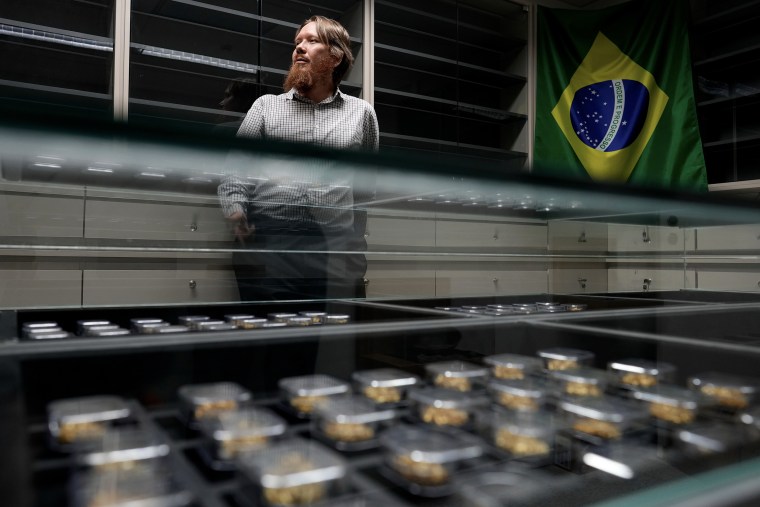
Brazil is employing forensic science to address illegal gold mining in the Amazon. This practice poses a major threat to the rainforest, Indigenous groups, and surrounding communities. It leads to increased deforestation and severe mercury contamination.
The National Institute of Criminalistics in Brasilia, Brazil’s capital, coordinates the efforts. Federal police have established a specialized ‘gold lab’ to collect and analyze samples nationwide.
The Gold Fingerprinting Method
The primary goal is to determine if new samples, like those seized during police raids, originate from protected areas, indicating illegal mining. This process, known as ‘gold fingerprinting,’ involves tracing the origin of gold samples precisely.
Experts liken gold tracing to DNA analysis. In the lab, tiny containers house sparkling gold flakes, but their true value lies in the data they hold. Each speck is unique due to particles absorbed during its formation, such as silver and copper traces.
Forensic expert Gustavo Geiser reveals that this method has been developed since 2019, involving tools like X-ray fluorescence spectrometry, scanning electron microscopy, and laser ablation mass spectrometry. Despite increasingly complex examinations, the consistent question remains: ‘Where did this gold originate?’
Combating Environmental Crimes
The forensics team assists police in building cases against environmental criminals in the Amazon, who often use fraud to insert their goods into legal markets. These include gold, cattle, and timber. A global surge in gold prices has intensified mining activity in the rainforest.
Amazon Mining Watch reports that about 496,000 hectares (1.2 million acres) of rainforest have been cleared for mining since 2023, including some 223,000 hectares (551,000 acres) in the Brazilian Amazon.
Illegal Practices and Regulatory Actions
The Federal Court of Accounts, Brazil’s top audit institution, previously indicated misuse of mining permits by small-scale miners. Greenpeace reported the ‘ghost mine’ scam, where activity claims don’t match satellite data, revealing operations on prohibited Indigenous lands.
Recently, a federal court in Para directed institutions like the Central Bank and the National Mining Agency to improve control and traceability. Federal prosecutors filed a lawsuit seeking better oversight of mining permits.
Prosecutor André Porreca explained that these permits help criminals launder gold extracted illegally. Geiser emphasizes that the Brasilia gold lab strengthens these efforts, ensuring the legitimacy of gold within financial reserves.
Regional Cooperation and Mercury Contamination
Regional collaboration is crucial, and neighboring countries like Venezuela, French Guiana, and Suriname have been implicated in laundering illegally mined gold. The Amazon International Police Cooperation Center supports cross-border efforts.
Illegal mining’s mercury usage devastates water sources and fish crucial to Indigenous communities. A study found high mercury levels in Amazonian markets’ fish, severely impacting young children’s health.
Brazil signed the Minamata Convention on Mercury, pledging to eliminate mercury use. A proposed ministry draft aims to phase out mercury, pending discussions with Indigenous groups.
Geiser states that banning mercury would enhance environmental protection and forensic investigations. Detecting mercury traces solidifies the illegality of mining activities using mercury.