
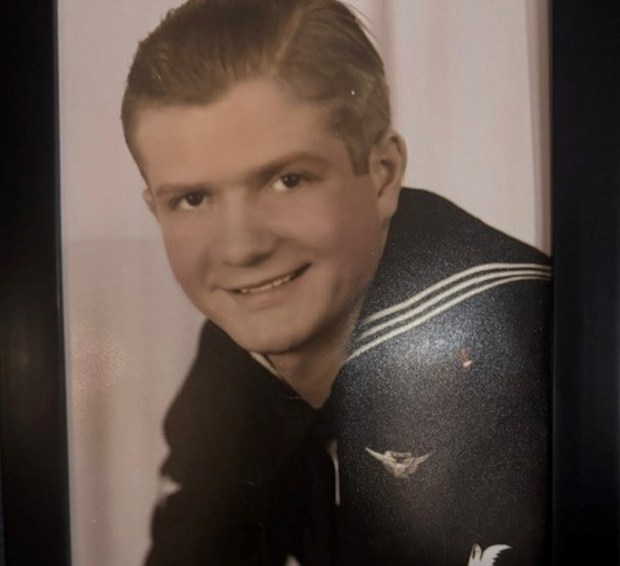
Bill Glennon moves with haste. When asked to visit the Wall of Honor at the Prairie Path senior living community in Lombard, the Navy veteran quickly heads to the elevator, unhindered by his walker or his age of 101. As America marks its 250th anniversary, Glennon expresses less reflection on a vibrant life and more astonishment at his continued presence.
Asked what guidance he might offer those aiming for a similar age, Glennon, a longtime Western Springs resident, simply states, “To tell you the truth, I don’t know – I’m amazed I’m here. The good Lord has let me stay so long and I enjoy myself all the time.” It’s challenging to assert that Glennon, originally from Maywood, hasn’t earned the right to fulfillment. His adventurous life nearly concluded in the icy waters of the North Pacific Ocean.
Glennon was only 17 on December 7, 1941, when Japan attacked Pearl Harbor. The next day, “a buddy and me went downtown and joined the Navy,” he recalls. “We wanted the Air Force, but they weren’t taking anyone that day.” Enlisted in the Navy Air Corps, Glennon trained as a gunner, stationed atop a PV-1 Ventura. His role involved shooting down enemy planes as his aircraft bombed Japanese targets, a schedule maintained every three days for nearly a year.
One mission ended abruptly when Glennon’s plane was downed by enemy fire over remote Alaskan waters. “A lot was going through my mind,” Glennon, by then 18, reflects. The primary concern: “Was I going to live?” He was the last to exit the plane, promptly activating his flotation device, aiding five others aboard, while watching another swim to safety.
Luckily, some fishermen, alerted by the aircraft’s lights and Glennon’s fired shot, came to their rescue. “One of our guys was just floating, unconscious,” remembers Glennon. “They picked him up. We worried they couldn’t reach us. But they turned around and brought us to their village. They saved our lives.”
The seven men received care from Alaskan villagers for four days before the Navy transported them to a Seattle hospital for recovery. Once fit for duty, Glennon was stationed in the South Pacific as a gunnery instructor. After the war, he returned to Maywood and his fiancée, Virginia. “She was waiting for me,” he recounts. “She set up the wedding, had it all planned.”
Married within a week of returning home, Glennon embarked on a teaching career and later became a principal at Butler Junior High School in Oak Brook. Though he impacted many students, Glennon rarely disclosed his wartime experiences. “Defending democracy was just something we had to do,” he maintains.
The Glennons celebrated 75 years of marriage, blessed with three children, seven grandchildren, and numerous great-grandchildren. “There are more coming,” he shares. After years in Western Springs, Glennon and Virginia pursued golf in retirement. Eventually, they moved to Prairie Path in Lombard, where they stayed until Virginia’s passing nearly five years ago.
“Love is the best thing there is. I was just so lucky,” Glennon reflects. Despite loss, he remains surrounded by friends and attentive staff at Prairie Path. His days begin with breakfast at 8 a.m. Followed by a walk outside that he does daily, despite giving up driving three years ago. In addition, his routine includes workouts in the exercise room.
Glennon participates in many activities, such as music and fitness. He often enjoys a Manhattan with lunch. With family residing nearby, visits are frequent. “They bring all the kids here to my place,” Glennon notes. Each Sunday, his daughter, Adriene, and her husband, Joel, host him for dinner at their home.
Leading up to the July Fourth weekend, Glennon stood before the Wall of Honor at Prairie Path, where a military photo of him as a young Navy recruit is displayed. Despite living through many changes, Glennon shares few thoughts on transformations in his lifetime. “I’ve tried to stay out of politics,” he admits. “My life has been good – I’ve been fortunate. Things were easier back then, now, I’m simply glad to be here.”
Jim Dudlicek is a freelance reporter for Pioneer Press.