
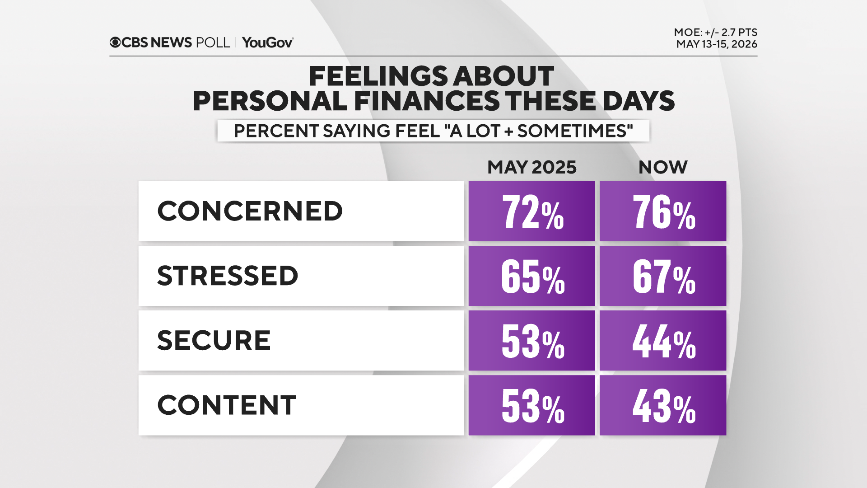
A large portion of Americans express significant concern and stress about their financial situations. Feelings of financial security and contentment have declined compared to a year ago. These sentiments contribute to the increasingly negative view of the U.S. economy. Current economic ratings are at their lowest since 2023, with 75% of people indicating that incomes are not keeping pace with inflation.
Many Americans describe the economy as ‘uncertain,’ reflecting both short-term and long-term worries. One immediate factor is rising gas prices, which are causing distress. Additionally, confusion surrounds events in Iran and the daily situation in the Strait of Hormuz.
Iran Conflict’s Economic Impact
The situation with Iran is a key reason many Americans view the economy as unstable. The conflict affects gas prices, and most people feel uninformed about the developments in the Strait of Hormuz. A substantial number of people do not believe the conflict has been beneficial to U.S. economic interests. While perceptions of military success are relatively better, many think it is premature to determine whether it advances U.S. strategic interests. There is mixed opinion on who holds the advantage, with many believing neither side does.
President Trump’s Economic Policies
President Trump faces political consequences due to the economic situation. Two-thirds of the population believe his policies are worsening the economy, at least in the short term. Although some of his administration suggest patience, there is only slight optimism that his policies might improve the situation long term. Many describe their feelings towards the administration’s economic approach as ‘frustrated’ or ‘angry.’ Consequently, his ratings for managing the economy and inflation continue to fall.
Even among Republicans, who generally support him in other areas, his handling of inflation receives declining ratings, particularly since the start of the Iran conflict and subsequent oil price increases. A third of Republicans who criticize him on inflation feel ‘frustrated’ rather than ‘angry.’ There is a noticeable gap between their approval of him on issues like immigration (89%) or overall performance (85%) and his inflation management (63%). His overall approval has decreased to the lowest point of his second term.
Political Implications and Future Outlook
Democrats aren’t widely viewed as offering a solution either. While they hold a slight advantage over Republicans in dealing with living costs, the Democrats’ approach to economic policy does not significantly differ. A large segment of the population believes neither party has a better strategy or remains unsure.
Looking ahead, there’s broad uncertainty about the economy. Many worry about finding desirable employment and fear that AI might take jobs. The overall outlook is pessimistic, with most anticipating a recession or economic slowdown.
The general economic sentiment is one of uncertainty and perceived unfairness, especially among Americans below fifty, who feel they have fewer opportunities than previous generations.
This CBS News/YouGov poll was conducted with 2,064 U.S. adults as a nationally representative sample between May 13-15, 2026. The sample accounted for gender, age, race, and education, adhering to the U.S. Census American Community Survey and Current Population Survey, along with the 2024 presidential vote. The margin of error is ±2.7 percentage points.