
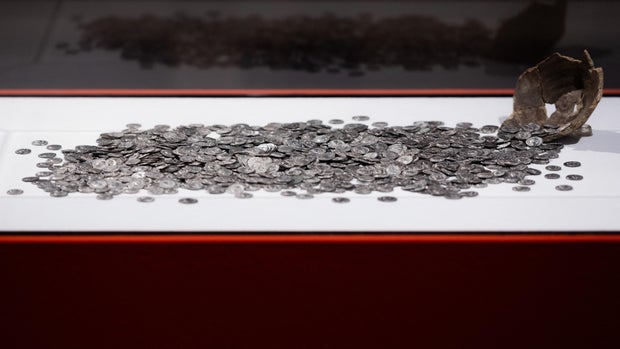
An amateur archaeologist named Oliver Riedl made a remarkable discovery in western Germany. Using a metal detector, Riedl found several Roman silver coins. However, the persistent beeping of his equipment suggested a much larger finding buried underground.
Riedl contacted local authorities for assistance. A team of experts began excavation and uncovered a total of 934 Roman silver denarii. This is the largest coin hoard from Roman Emperor Hadrian’s time ever found in Germany, according to the archaeological office responsible for monuments.
“It was clear to me that there was something bigger buried here,” Riedl said, recalling his experience with the metal detector near Wesseling, south of Cologne.
The collection weighs 3.1 kilograms (6.8 pounds) and is currently displayed at the LVR-LandesMuseum Bonn. Most of the coins date back to the Flavian emperors’ reign (A.D. 69–96), though the oldest dates to 148 B.C., according to the museum.
The LVR Office for the Preservation of Archaeological Monuments in the Rhineland suggests the coins were likely intentionally buried during the second quarter of the second century A.D.
“Of course, we can only speculate about the motives, but it’s very likely that someone wanted to keep this money safe. After all, banks didn’t exist back then,” Erich Classen, the state archaeologist and director of the office, explained.
Reasons for the treasure not being recovered earlier remain unclear. Classen noted possibilities like the owner’s untimely death, preventing them from retrieving or divulging details about the coins.
While treasures from ancient Rome and other eras are not rare, few are as sizable as the Wesseling find. Estimating the value of the coins during their creation is challenging.
Roman legionaries’ pay offers some insight. “At that time, an ordinary soldier in the legion earned 300 denarii a year. However, about half of that was withheld for food and equipment,” Rahel Otte, a research associate at the archaeological office, said. This means a soldier would have to save all disposable income over six years to accumulate the hoard seen at Wesseling.
The exact person who amassed the fortune remains unknown.
The Cologne region was under Roman control from 39 B.C. to A.D. 459. The Romans established their presence in the area under the leadership of General Marcus Vipsanius Agrippa. His efforts secured the empire’s border along the Rhine River and led to the foundation of Colonia Agrippina, known today as Cologne.
In recent years, other treasures from the Roman era have been uncovered across Europe. In early 2024, Roman coins worth over $125,000 were found during construction in central England. Metal detectorists also helped discover ancient Roman coins in Poland and a cache of silver Roman coins on a Mediterranean island.