
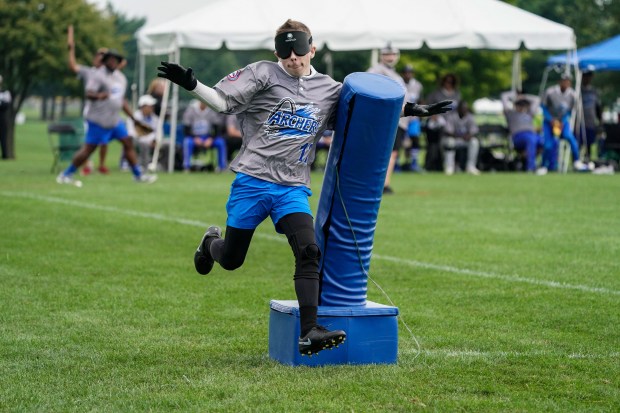
Silence dominates the field. Sideline chatter halts, with only a constant beeping from the ball. The pitcher calls a few words, alerting the blindfolded batter to prepare to swing. Then, the sharp sound of impact—the batter sprints toward a buzzing base 100 feet away. Except for a field ‘spotter’ announcing the ball’s direction, the silence persists. Action continues as blindfolded fielders dive to catch the ball. The runner crashes into the padded base, then tumbles to the ground.
For newcomers, Beep Baseball might seem chaotic. But during my first game at Aurora’s Stuart Sports Complex on a recent Wednesday, I quickly saw that this adaptive sport blends athleticism with trust and communication. It’s clear why the DuPage Sports Commission teamed up with the Aurora Area Convention & Visitors Bureau and the city of Aurora to host the 50th National Beep Baseball Association World Series. The five-day event, starting Tuesday, drew over 500 visually-impaired athletes from across the nation to Aurora. The tournament wraps up Saturday at 9 a.m., with the top two teams from 21 coast-to-coast squads vying for the title.
Michael Finn, a lifelong advocate for athletes with visual impairments, aims to be in the final. After losing 85% of his eyesight at age 3 due to a medical error damaging his optic nerve, this 57-year-old Sacramento native became a Paralympian in track and field. For over three decades, he’s been a dedicated Beep Baseball player. Despite impressive achievements with his former team, West Coast Dawgs, his archrival Blackhawks from Texas, boast nine world titles and remain unbeaten in this tournament.
Finn notes, “Everybody here has a good story.” Many competitive teams aim for Saturday’s final, like the Indy Thunder, with six national titles, and St. Louis’ Gateway Archers, dominating the tournament early on without a loss.
Avery Kilmer from the St. Louis Gateway Archers reaches base against the New York Bombers during the 2026 World Series.
In this adaptive sport, sound is crucial. Players hit and field the ball following its beep and race 100 feet to tackle a buzzing foam base before the defense outs them. The pitcher’s team, including the catcher, assist the batter. Reaching baselines counts as a run. Players wear blindfolds to ensure fair play despite varying degrees of vision, and silence prevails among spectators until a play concludes. Two spotters announce the hit ball’s location, prompting defenseless players to pursue the ball before the runner scores.
Tanueer Ahmed, from the New York Bombers, fields a grounder during the 2026 World Series.
Glen Capek, who produced “Beep Baseball: The Unseen Sport,” grew up around these games as his late father volunteered for the NBBA for years. Trust is vital for players relying on sighted spotters. Beep Baseball began in 1964 when engineer Charles Fairbanks inserted a beeping device into a softball for blind children. In 1976, advocates from various states established the NBBA. Chicago remains the only consistent World Series participant, with the Chicago Comets winning in 2003.
Illinois hosted the World Series twice, in Chicago in 1990 and Glenview in 2002. When Igor Bakovic from the DuPage Sports Commission learned about Beep Baseball, he propelled efforts to bring the tournament back to the state. Collaborating with the Aurora Area Convention & Visitors Bureau, they provided accommodation and a venue for 100 games in a week. Bidding finalists Bakovic and Brad Banks attended the prior year’s World Series in St. Louis, becoming fans.
“We were thrilled to secure the event,” Bakovic says, marking the 50th anniversary celebration. While competitive, the tournament serves as a reunion for players, families, and volunteers united by a sport shaping lives.
Faith Penn, a Blackhawks player blinded by a soccer-related injury, values her team greatly. “Travel and meeting new people feel liberating,” she shares, relishing the rush of base runs. For NBBA Hall of Famer Darnell Booker, Beep Baseball transformed his life after a BB gun incident at 15. He founded the Indy Thunder and evolved into the organization’s vice president and tournament director, proud of the sport’s global expansion to 30 US teams and international squads.
Ty Brown and Tanueer Ahmed from the New York Bombers connect after a play against the Gateway Archers.
Tournament participation depends not on wins but on fundraising efforts, as teams strive to afford the costly sport. Gateway Archers fan Marge Sanders admires volunteers supporting in areas like hospitality and field operations. “Everyone’s so encouraging,” she whispers from the sidelines, awaiting her team’s next game.