
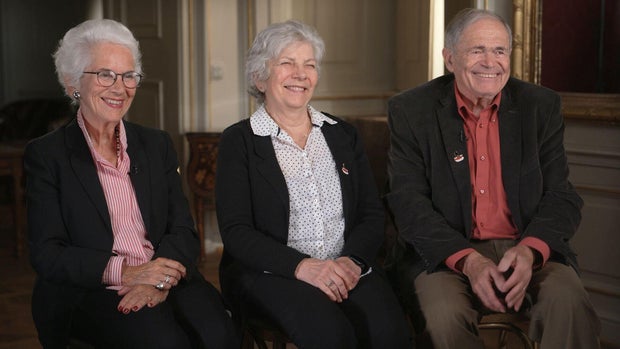
May 2025 marked 80 years since the end of World War II in Europe and the liberation of Nazi concentration camps. Despite the passage of time, new stories of Holocaust survival continue to emerge. One remarkable story involves three women who, in 1944, were sent to Auschwitz while pregnant. The crime of pregnancy was punishable by death, yet they managed to deceive their captors and give birth to children who would turn 80 years old.
Lesley Stahl spoke with the survivors, who are often referred to as ‘the babies’ despite being octogenarians. Eva Clarke, Hana Berger-Moran, and Mark Olsky were born in spring 1945, just before Germany surrendered. Their mothers, Anka from Czechoslovakia, Rachel from Poland, and Priska from Czechoslovakia, had been young Jewish women facing the impending horrors of war.
These women and their families were caught in the terror as the Nazis occupied Europe. Jews were rounded up and sent to camps. For Eva Clarke’s mother, pregnancy was a crime due to the Nazi agenda to eradicate the Jewish people.
Eva Clarke stated, “Becoming pregnant in a camp was a crime as they tried to annihilate every Jewish member.”
By late 1944, with ghettos liquidated, each woman boarded a train to Auschwitz with loved ones. Upon arrival, families were separated, and many were sent to die in gas chambers. Those selected for work ended up in barracks rife with cruelty.
Despite the danger, the three mothers denied their pregnancies to infamous Nazi doctor Josef Mengele, which possibly saved their lives. Taken to a labor camp in Germany, they worked in a factory under dire conditions, hiding their pregnancies under clothes taken from deceased inmates.
By 1945, as the Allies advanced, the Nazis planned to eradicate evidence. All three mothers were put on a train intended to transport them to their deaths. Hana’s mother gave birth under unspeakable conditions; guards watched the birth like a spectacle.
The train journey, spanning weeks without food or water, ended at Mauthausen camp. Just before arrival, Eva’s mother went into labor. Shockingly, they discovered that the camp had run out of gas for the chambers, barely sparing their lives.
Upon liberation by American forces, young medic Leroy “Pete” Petersohn treated Hana and ensured her survival. Though the babies lost their fathers during the war, their mothers lived on to raise them alone. Each learned about their beginnings in fragments from their moms.
Years later, unexpected connections brought the three survivors together. Hana Berger-Moran sought out the medic who saved her. Through heartfelt exchange, she connected with Pete Petersohn, forming a familial bond.
The three babies first met in 2010, sharing birthdays and stories while visiting the Mauthausen memorial. Eva Clarke later uncovered that her own liberation intersected with Hana’s narrative. Through a chance online discovery fueled by her son, Mark Olsky found these long-lost companions.
In 2025, the three were celebrated at the 80th anniversary of Mauthausen’s liberation. Walking together through the camp, they honored the memory of their mothers, who had courageously endured so much.
Eva Clarke said, “In the end, we won,” a sentiment shared as they reflected on their survival and families.
The stories of survival, bonded through fate, have continued with each having children and grandchildren. The lives they lead now serve as a tribute to the strength and resilience of their mothers.